Product Fidelity in AI Image Generation: Why What You Upload Must Be What Ships
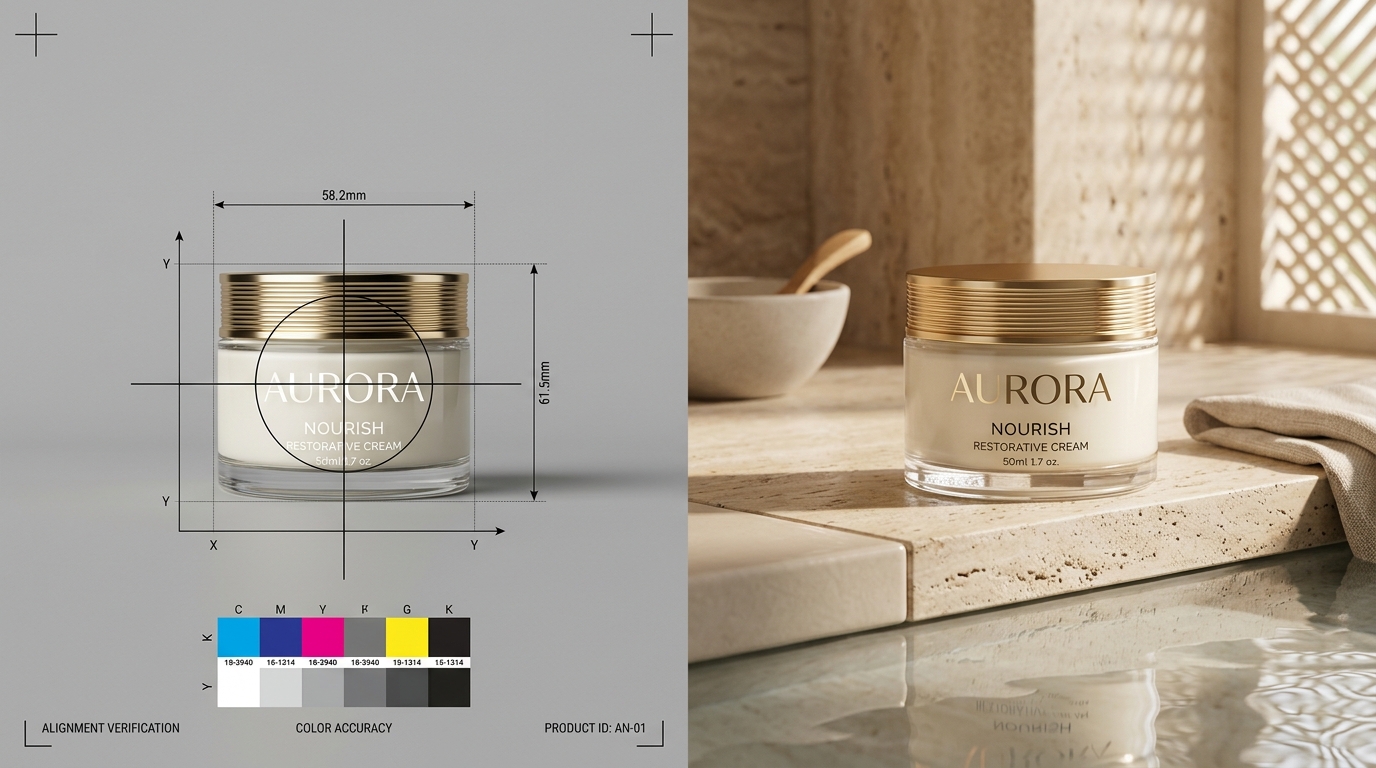
Every ecommerce merchant shares the same recurring nightmare: a customer opens a newly delivered package, looks down at the physical item, looks back up at their phone screen, and immediately files a return with the note: "Item looks nothing like the listing photo."
In online retail, photographic discrepancy is the number one driver of avoidable customer returns. When consumer image generators first emerged, brands experimenting with them quickly ran into a wall: the images were aesthetically stunning, but the AI had altered the brand logo, invented buttons that didn't exist, smoothed over subtle fabric ribbing, or shifted an olive-green jacket into a forest-green coat.
This phenomenon is known as product drift. For AI photography to be commercially viable for real brands, the technology cannot invent or reinterpret the product. This guide defines what product fidelity actually means across all physical categories, examines the five structural pillars of visual accuracy, and explains how modern product-conditioned pipelines eliminate drift entirely.
What Is Product Drift (And Why Does It Cost Brands Real Money)?
Product drift occurs when generative AI modifies any physical characteristic of an uploaded SKU during the background synthesis or lighting process. While subtle artistic license might be acceptable in concept art or digital illustrations, in ecommerce it represents a direct financial liability:
- Inflated return logistics: Processing returns consumes 20% to 30% of a physical item's retail value in shipping, restocking, and repackaging fees. When returns are driven by visual expectation mismatch, those losses are completely unforced errors.
- Customer acquisition cost burn: If a shopper's first purchase results in an expectation mismatch, your second-order retention rate drops close to zero, destroying customer lifetime value (LTV).
- Marketplace penalty algorithms: Platforms like Amazon and Walmart actively track return reason codes. Listings with elevated "Not as described" or "Item different from website" complaint rates suffer algorithmic rank demotions or outright buy-box suppression.
The 5 Pillars of Commercial Product Fidelity
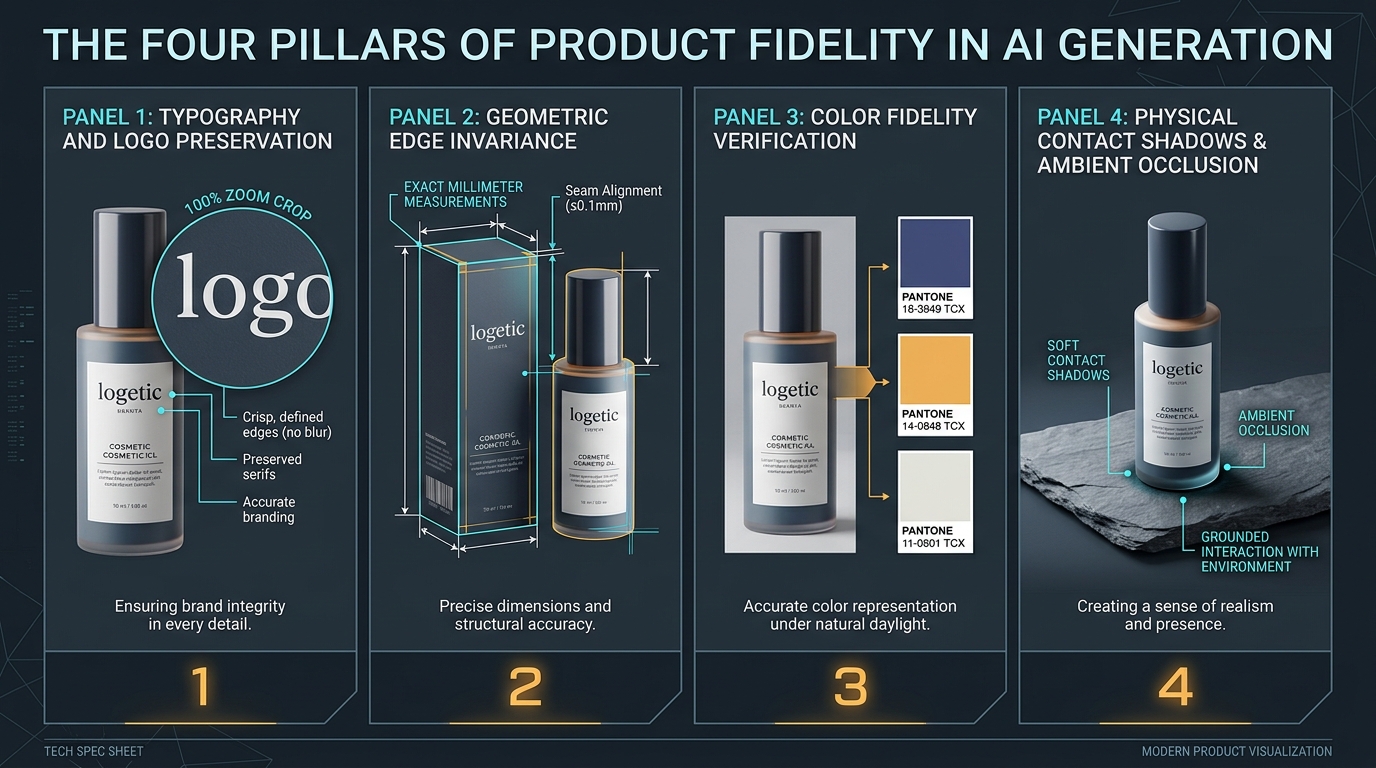
To evaluate whether an AI-generated product image is safe for commercial publishing, inspect it against the five foundational pillars of physical fidelity:
1. Geometric Invariance (Zero Shape Morphing)
The physical outline, bevels, curvature, aspect ratio, and structural lines of your product must remain constant. If you upload a cylindrical cosmetic bottle with a 50mm diameter, the generated output must not taper into a cone or stretch into an oval. Conditioning models enforce geometric invariance by anchoring spatial depth vectors (ControlNet maps) to the input photograph.
2. Micro-Typography & Packaging Legibility
Generic AI generators view text as abstract textural patterns rather than structured glyphs, resulting in the notorious "alien script" gibberish. In a high-fidelity pipeline, the packaging label, ingredient list, brand trademark, and barcode are isolated in a protected mask layer that is bypassed during diffusion and re-composited with sub-pixel sharpness.
3. Color Accuracy & Delta-E Tolerance
In industrial colorimetry, color difference is measured as Delta-E (ΔE). A ΔE value under 1.0 is virtually imperceptible to the human eye, while a ΔE between 1.0 and 2.0 is considered the commercial standard for high-end retail lookbooks. When ΔE exceeds 3.0, shoppers immediately perceive a distinct color mismatch. Modern fidelity engines use histogram color correction to ensure that simulated warm sunlight does not permanently shift your product's signature brand hex code.
4. Physical Materiality & Specular Surface Response
A genuine product photo clearly communicates material quality: matte ceramic absorbs light with a broad diffuse falloff; polished chrome produces tight specular highlights reflecting nearby surfaces; frosted glass blurs the background visible through its body. High-fidelity engines calculate surface normals to apply realistic environment reflections without flattening material textures.
5. Scale & Contextual Proportion Grounding
One of the most common subtle failures in AI generation is proportion distortion: placing a 15ml eye-cream jar next to a water glass where the jar appears larger than the glass itself. True fidelity requires scale-aware spatial conditioning, ensuring props, furniture, and human models match real-world physical dimensions.
Comparing Consumer Generative AI vs. Product-Conditioned Diffusion
The table below illustrates the stark operational differences between unconstrained generative models and commercial fidelity-preserving pipelines:
| Evaluation Dimension | Consumer Text-to-Image AI (Midjourney, DALL-E) | Product-Conditioned Diffusion (SocialShot) |
|---|---|---|
| Product Branding | Hallucinated or misspelled brand typography | 100% pixel-accurate to original physical label |
| Structural Seams & Hardware | Invented or missing buttons, zippers, caps | Locked to real input geometry via spatial maps |
| Color Consistency | Arbitrary color drift based on scene prompts | Histogram color calibration (ΔE < 1.5 tolerance) |
| Multi-Angle Set Consistency | Zero consistency between front and side views | Maintains identical product details across full carousel |
| Commercial Suitability | Concept art and inspirational moodboards only | Marketplace-ready PDP heroes, ads, and catalogs |
How Modern Conditioning Prevents Drift
How do commercial platforms ensure zero drift while still rendering photorealistic new environments? The architecture relies on three interconnected safety gates:
- Sub-pixel foreground protection: Rather than allowing the neural network to redraw the entire image, the system creates a high-precision binary/alpha mask of the product. The original pixels within the mask are held invariant throughout the latent diffusion cycle.
- Surface contact calculation: To prevent the product from looking like a pasted sticker, the diffusion model is instructed to calculate contact geometry only in the immediate boundary zone (10 to 20 pixels around the perimeter), generating realistic contact shadows and subtle environmental color bleed.
- Neural super-resolution and unsharp masking: After scene synthesis, a high-pass frequency filter restores micro-textures (such as paper grain on cardboard, pebble grain on leather, or brushed metal lines) that compression might have softened.
For a deeper technical walkthrough of this mathematical pipeline, read our deep-dive on how AI product photography works under the hood.
How SocialShot Guarantees Zero-Drift Outputs
SocialShot was built from the ground up to solve the fidelity dilemma for ecommerce merchants. Whether you are generating on-model fashion imagery, cosmetic studio scenes, or Amazon-compliant pure white cutouts, your physical product remains untouched.
With SocialShot's product photoshoot studio, you can confidently scale your visual production across hundreds of SKUs knowing that what customers see on their screens is exactly what arrives on their doorsteps.
Generate commercial scenes with 100% product fidelity
Protect brand integrity, eliminate product drift, and generate high-converting catalog visuals with SocialShot AI.
Frequently Asked Questions
What is the difference between image fidelity and image realism?
Realism means an image looks physically plausible and photographic to the human eye. Fidelity means the image accurately and truthfully depicts the exact manufactured specifications, colors, labels, and dimensions of a specific real-world product. An image can be 100% realistic while having 0% fidelity if it alters your product.
How does lighting affect color accuracy in AI generation?
In the physical world, warm golden-hour sunlight casts an amber hue over objects, while cool overcast skies introduce bluish tones. High-fidelity AI engines apply environmental lighting while utilizing color-balance recovery algorithms to ensure your product's fundamental surface color remains identifiable and within acceptable marketplace tolerances.
Can AI product photography preserve intricate reflective materials like jewelry?
Yes. By analyzing surface normal depth maps, specialized product engines can render realistic environmental reflections (such as studio softboxes or dark velvet backdrops) across gold, silver, and gemstones without wiping out facets or altering metallic finishes.
Why do some AI tools distort product labels and text?
Tools that redraw the entire image from scratch cannot replicate structured text because generative models treat letters as abstract graphical noise. Platforms with product-conditioning preserve your original photo's pixel data inside the product boundary, leaving typography crisp and untouched.
How can I test whether my AI product photos have drifted?
Place your physical product on your desk directly beside your computer monitor showing the generated photo. Compare five specific check-points: label typography, seam placement, colorway tone under neutral daylight, proportion of components, and surface texture.
Does high product fidelity matter for social media ad creatives?
Yes. While social media ads allow for more expressive, stylized lifestyle backgrounds, the core product being advertised must remain accurate. Misleading ad creatives drive high initial clicks but result in high return rates and poor ad platform quality scores once customers receive the actual item.