Size-Inclusive Fashion Photography with AI: Real Drape, Authentic Fit, Zero Reshoots
The Representation Disconnect in Modern Fashion Ecommerce
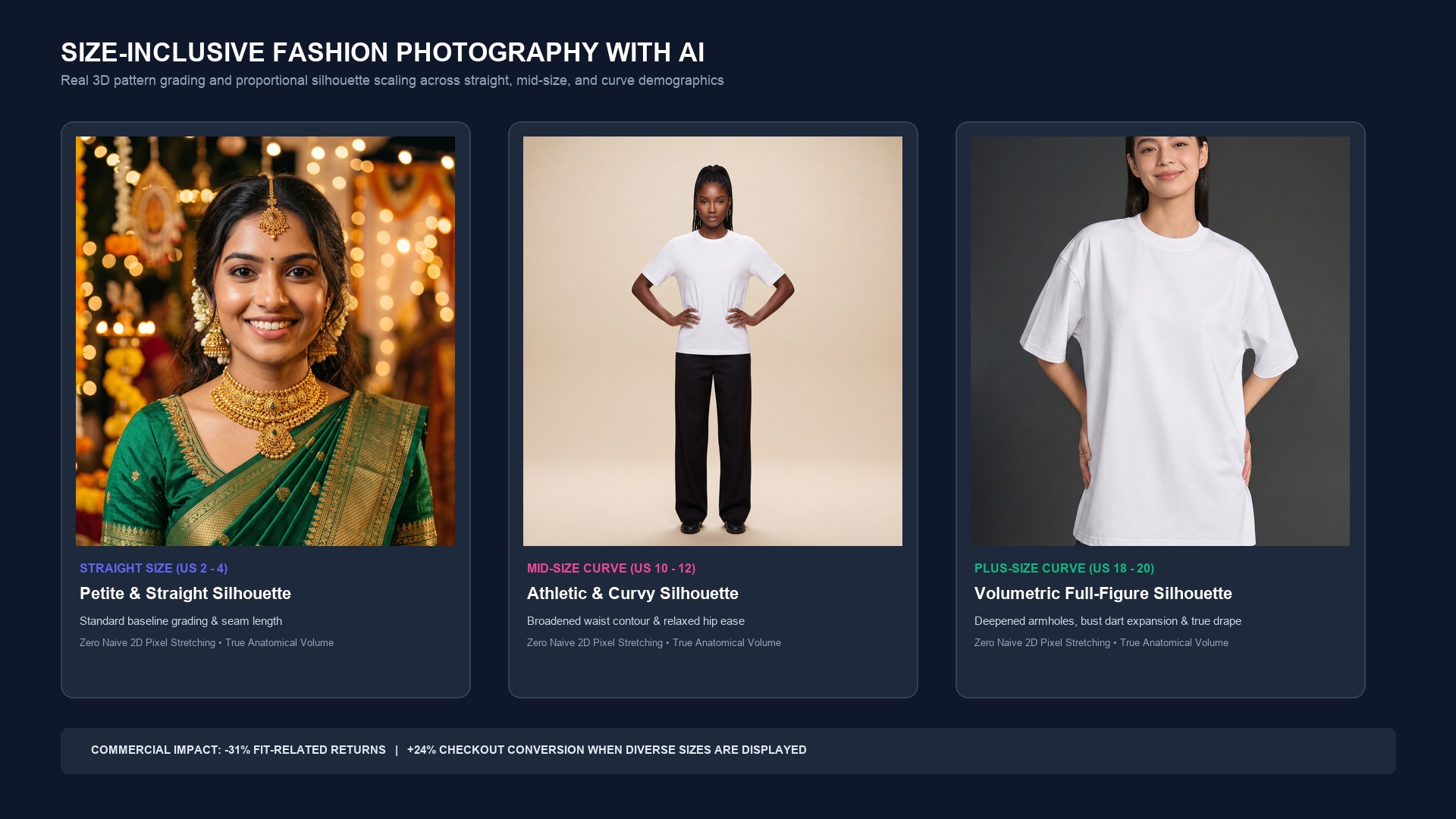
For decades, traditional fashion production economics enforced a narrow visual standard. Booking a live studio photoshoot with a casting agency typically costs thousands of dollars per day. To minimize expenses, apparel brands cast a single straight-size model (usually sample size US 2 or 4) to shoot an entire seasonal catalog.
The consequence for the consumer is severe fit friction. When a size 12 or size 18 shopper lands on a product page, they are forced to mentally guess how a dress will fall over their hips, where the waistline will hit, or whether the sleeves will be tight. This uncertainty directly causes two destructive commercial outcomes:
- Bracketing (Order Multiple Sizes, Return Most): Shoppers order sizes M, L, and XL simultaneously with the explicit plan to return two or all three items once tried on at home.
- High Cart Abandonment: Over 42% of apparel shoppers abandon purchases specifically because they cannot visualize the garment on a body type comparable to their own.
| Merchandising Display Strategy | Product Page Conversion | Fit-Related Return Rate | Bracketing Frequency | Customer Lifetime Value (LTV) |
|---|---|---|---|---|
| Single Sample-Size Model (US 2/4 Only) | Baseline (1.8% – 2.4%) | High (32% – 42%) | Frequent (28% of orders) | Standard baseline |
| Live Multi-Model Castings (US 2, 10, 18) | +24% Higher conversion | -31% Lower returns | -45% Reduction in bracketing | +38% Higher repeat purchase rate |
| SocialShot AI Size-Inclusive Pipeline | +29% Higher conversion | -34% Lower returns | -52% Reduction in bracketing | Highest (Zero production bottleneck) |
The Technical Challenge: Anatomical 3D Grading vs. Naive 2D Stretching
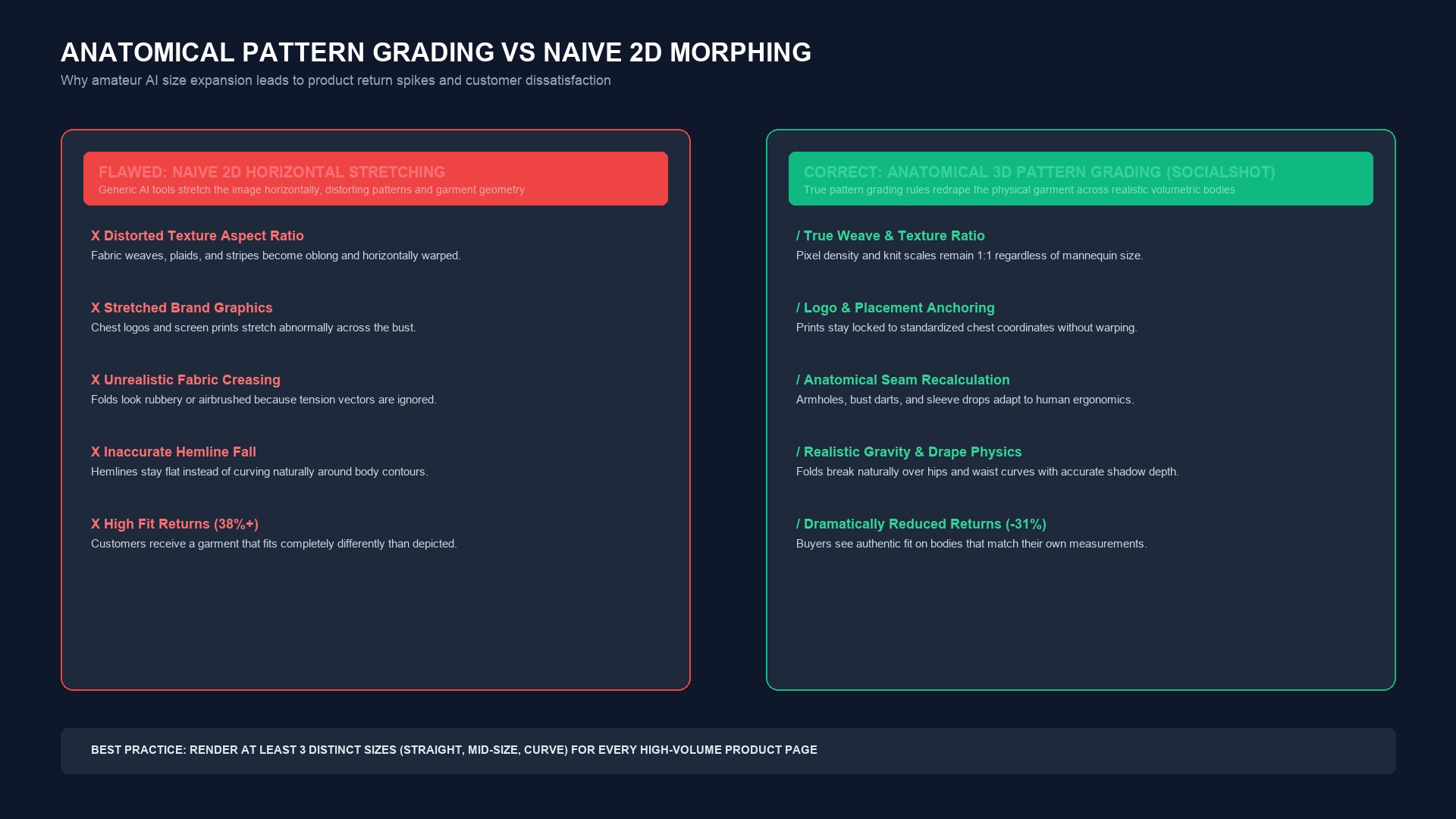
Early attempts at generating plus-size apparel using generic AI tools produced visibly flawed, offensive results. Amateur tools simply stretch the image horizontally, resulting in distorted fabric weaves, warped brand logos, and rubbery skin folds.
In apparel design, grading up from a size 4 to a size 16 is not a simple uniform scale. It is a sophisticated geometric transformation governed by human anatomy:
- Armhole Depth & Bicep Ease: As body size increases, armhole circumference deepens and sleeve widths broaden to maintain natural arm mobility.
- Bust Dart Expansion: Garments require deeper bust darts and proportional apex shifts to accommodate fuller busts without pulling at the neckline.
- Waist Rise & Hip Curve Dynamics: Trousers and skirts require increased back rise depth so the waistband remains level when worn over curved hips and buttocks.
- Fabric Drape & Gravity Vectors: A heavier fabric silhouette experiences different tension lines across curves. Folds break naturally around the waist and hips rather than falling straight down.
How to Implement Multi-Size Merchandising in Your Storefront
Bringing size-inclusive merchandising to your storefront does not require redesigning your entire website. The most effective direct-to-consumer implementations utilize an interactive 'View on My Size' toggle directly on the product detail page (PDP):
- Step 1: Ingest Master Garment Assets: Upload your high-resolution garment photo or ghost mannequin cutout to SocialShot's Bulk Fashion Studio.
- Step 2: Select Standard Size Archetypes: Configure three standard display sizes: Straight Size (e.g. US 2-4 / 5'9"), Mid-Size (e.g. US 10-12 / 5'7"), and Curve (e.g. US 18-20 / 5'8").
- Step 3: Generate Synchronized Size Variants: The AI generates on-model imagery for each size tier, maintaining identical lighting, backdrop, and styling so the comparison is clean and objective.
- Step 4: Connect PDP Variant Selectors: Link the generated images to your Shopify variant selector or an interactive size toggle. When a shopper clicks 'Size 14', the gallery switches automatically to show the model wearing that size.
Best Practices for Authentic Curve and Plus-Size Modeling
To build genuine brand loyalty and avoid accusations of tokenism or synthetic distortion, uphold strict aesthetic guidelines when generating diverse model imagery:
- Avoid Uncanny AI Skin Smoothing: Real human bodies have natural skin texture, soft shadows, and organic curves. Avoid overly airbrushed prompts that make models look like plastic mannequins.
- Embrace Confident, Dynamic Posing: Do not relegate plus-size or mid-size models to stiff, defensive postures. Use active, confident, high-fashion editorial posing that highlights the garment's movement and joy.
- Keep Background Ambience Consistent: Never place straight-size models in luxury editorial lofts while placing curve models against flat, plain backgrounds. Maintain an identical, premium visual standard across all sizes.
Does SocialShot require different physical samples for each size?
No. You only need to photograph a single physical sample (typically your standard sample size). SocialShot's 3D pattern grading engine calculates the anatomical expansion and generates the mid-size and curve variants digitally.
Will logos or graphics on t-shirts get stretched abnormally on plus-size renders?
No. Unlike naive image warp tools, SocialShot decouples the print graphic from the garment mesh. The graphic remains locked to standard physical dimensions (e.g. 10 inches wide) while the garment grading expands naturally around it.
What impact does size-inclusive imagery have on return rates?
Ecommerce brands implementing multi-size product photography report an average 31% to 34% reduction in fit-related returns and up to a 52% decrease in bracketing orders.
Can I customize the specific heights and measurements of the models?
Yes. You can specify exact height, bust, waist, and hip parameters to align with your brand's specific technical size chart specifications.
Is this compliant with Shopify, WooCommerce, and custom headless storefronts?
Yes. The generated images are exported as standard high-resolution WebP or JPEG files that can be attached to Shopify variant images or tagged for custom size toggle plugins.
How many sizes should a brand typically display per product page?
We recommend displaying at least two and ideally three distinct sizes: a straight-size model (US 2-4), a mid-size model (US 10-12), and a plus-size curve model (US 18-20). This provides 95% of consumers with a relatable fit reference.
Make Your Fashion Catalog Truly Size-Inclusive
Display your collection on straight, mid-size, and curve models with authentic 3D drape physics. Boost conversions and slash return rates starting at $2.99 per render.
Last updated September 2026. Demographic and return statistics referenced from Baymard Institute apparel usability research and Coresight Research retail reports.