Product Photography API Use Cases: Automating Ecommerce Visuals at Scale
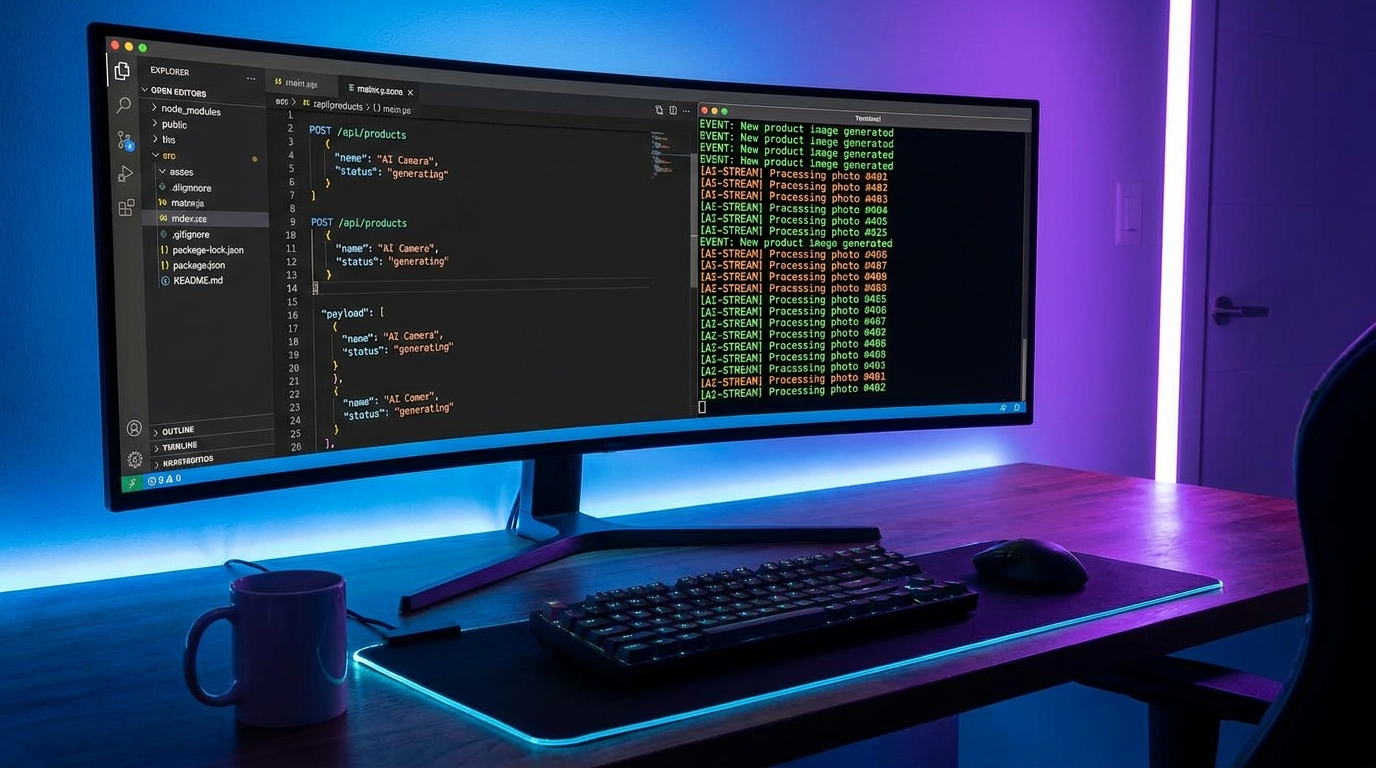
Why Platforms Are Transitioning to Headless Imaging APIs
As ecommerce catalogs expand into tens of thousands of SKUs, human-in-the-loop creative workflows break down. Traditional design studios take days to process new inventory batches, and web-based drag-and-drop SaaS tools still require hundreds of clicks from catalog operations teams.
Headless commerce architectures demand headless visual infrastructure. Through the SocialShot Developer Platform, engineering teams interact with high-performance REST endpoints and asynchronous webhooks to trigger studio-grade imaging jobs directly from code.
Whether your stack is built on Node.js, Python, Go, or Ruby on Rails, integrating a generative photography API transforms creative production from a human labor constraint into an automated, horizontal cloud workload.
Top Enterprise API Use Cases for Product Visuals
Engineering and product teams leverage photography APIs across four primary high-volume business categories:
- Marketplace Seller Ingestion & Auto-Standardization: Aggregator platforms receive thousands of merchant images daily in wildly inconsistent formats. APIs automatically validate resolution, strip cluttered backgrounds, center products within standard bounding boxes, and inject pure white HEX #FFFFFF backgrounds instantly.
- Print-on-Demand (POD) Dynamic Mockups: Rather than displaying flat 2D graphic templates, POD platforms use generative APIs to place custom apparel designs onto realistic, diverse human models across multiple lifestyle environments in near-real-time.
- Enterprise PIM & ERP Catalog Sync: Connect catalog master systems (Akeneo, Salsify, Pimcore, SAP) to automatically generate lifestyle contextual images whenever a new SKU status changes to 'Approved'.
- Real-Time Ad Creative Personalization: Performance marketing platforms generate dynamic creative variations tailored to audience segment, local weather conditions, or seasonal sales events on the fly.
Comparing Architecture Models: Manual vs. Headless Photography API
Review the technical specifications, latency, and cost trade-offs between traditional studio setups, web SaaS applications, and headless API pipelines:
| Architectural Dimension | Traditional Photo Studio | Web SaaS Tool (Browser) | Headless Photography API |
|---|---|---|---|
| Ingestion Mechanism | Physical product shipping | Manual file drag-and-drop | Automated JSON / REST Payload |
| Average Latency per SKU | 5 – 14 business days | 2 – 5 minutes per asset | 3 – 8 seconds (Asynchronous) |
| Throughput Concurrency | 1 SKU per photographer | Single browser session | 1,000+ concurrent worker tasks |
| Cost per Finished Image | $25.00 – $75.00+ | $0.50 – $2.00 labor + sub | $0.04 – $0.12 API compute |
| Integration Capability | None (Manual email/FTP) | Manual CSV upload/download | Full CI/CD, PIM, ERP, & Webhooks |
Anatomy of an Event-Driven Photography Pipeline
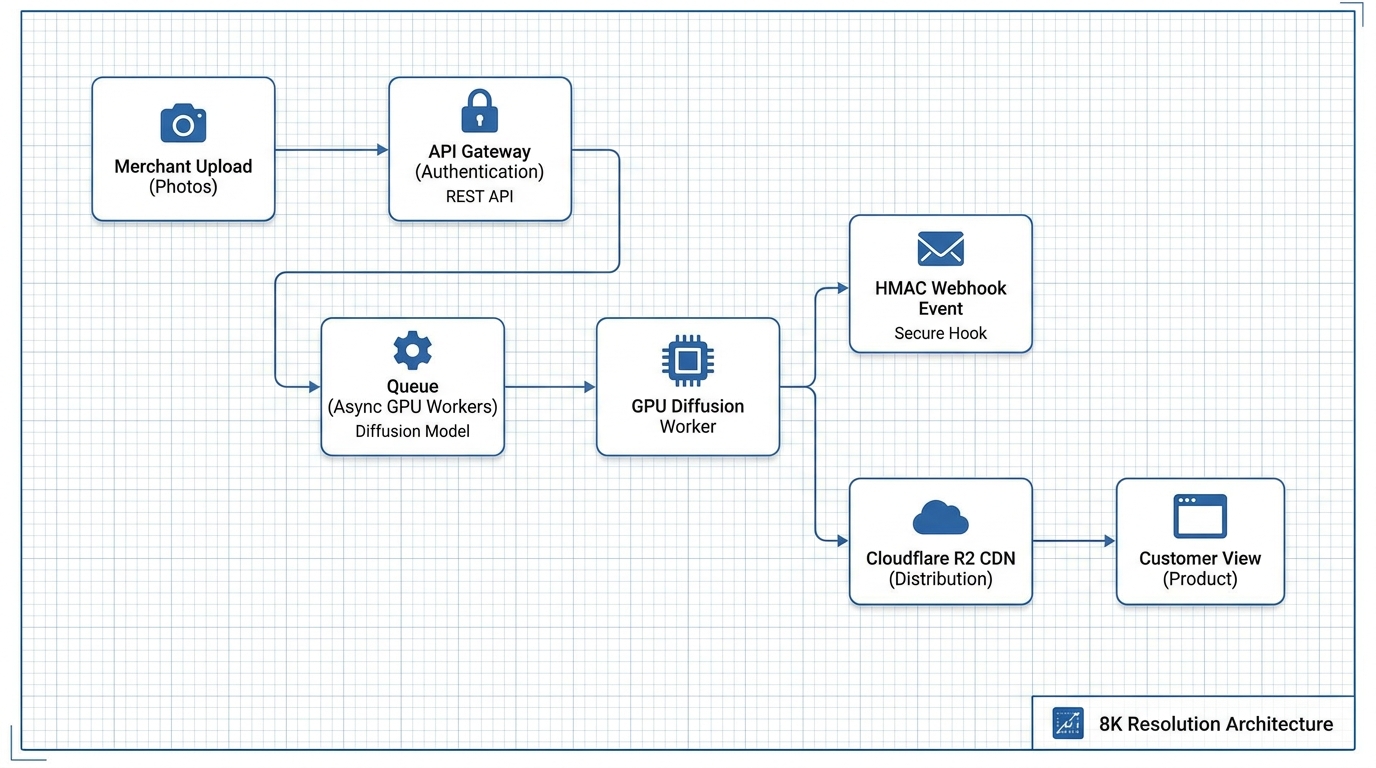
Production implementations of the SocialShot API follow an asynchronous, event-driven pattern designed for high reliability and zero socket timeouts:
- Payload Submission: Your application dispatches a POST request to `/api/v1/generate` containing the source image CDN URL, prompt instructions, desired model demographics, lighting preset, and a secure webhook callback URL.
- Queuing & Task Allocation: The SocialShot API gateway validates request parameters, deducts credits, assigns an idempotency key, and pushes the job to a distributed GPU worker pool, immediately returning a `202 Accepted` response with a `task_id`.
- Diffusion & Product Fidelity Synthesis: Edge workers execute segmentation, depth map estimation, color profile preservation, and contextual shadow rendering without altering the physical geometry of your product.
- Webhook Callback & Delivery: Upon completion, SocialShot sends an HMAC-SHA256 signed POST payload to your designated webhook endpoint with pre-signed high-resolution CDN download URLs.
Engineering Best Practices for High-Volume Integrations
When architecting an automated imaging pipeline, incorporate these enterprise integration patterns:
- Leverage Idempotency Keys: Include an `Idempotency-Key` header with your internal SKU UUID or content hash to prevent duplicate billing during network retry events.
- Verify Webhook Signatures: Always validate the `X-SocialShot-Signature` header using your account's webhook signing secret to protect your ingestion server from spoofing attacks.
- Implement Exponential Backoff: Gracefully handle temporary concurrency rate limits (`429 Too Many Requests`) with jittered exponential backoff algorithms.
- Asset Caching & Edge Propagation: Cache returned images on your own Cloudflare R2, AWS S3, or Google Cloud Storage bucket to ensure optimal end-user delivery speed.
What is a product photography API?
A product photography API is a programmatic interface that enables developers to automate background removal, lifestyle scene generation, on-model fashion visualization, and marketplace compliance formatting directly from their applications without manual photo editing.
How does asynchronous webhook delivery work in photography APIs?
Because generative AI rendering takes between 3 and 10 seconds per image, the API operates asynchronously. Your server receives an immediate 202 Accepted status with a task ID, and SocialShot dispatches a signed webhook containing the completed asset URLs once processing finishes.
Can the API preserve true garment color and physical fabric textures?
Yes. SocialShot's API utilizes specialized product fidelity algorithms and boundary segmentation to lock garment logos, hardware, seams, and fabric textures while generating realistic surrounding environments and lighting.
How does the API integrate with platforms like Shopify or BigCommerce?
Developers use Shopify App webhooks (such as `products/create` or `products/update`) to trigger SocialShot API generation requests, automatically re-uploading the enhanced high-resolution images back to the Shopify product media gallery.
What rate limits and concurrency controls are supported?
Enterprise API keys support up to 500 concurrent generation threads with bursting capabilities. Custom rate-limit tiers are available for marketplace aggregators processing millions of monthly SKU updates.
Does SocialShot provide client SDKs and OpenAPI specifications?
Yes. SocialShot maintains full OpenAPI 3.1 specifications along with official SDKs for TypeScript/Node.js and Python, complete with full type definitions and webhook verification utilities.
Build Studio-Grade Imaging Directly Into Your Platform
Integrate SocialShot's high-fidelity product photography REST API into your marketplace, PIM, or workflow app with comprehensive OpenAPI documentation.