Multi-Marketplace Compliance at Scale: Synchronizing Images Across Amazon, Walmart, and Shopify

The Omnichannel Compliance Trap: The High Cost of Disapprovals
Every major retail marketplace enforces strict algorithmic image quality checks during listing intake. If your agency or brand uploads an off-white background (RGB 245, 245, 245) to Amazon, the listing is silently suppressed from search results, choking off organic sales without warning.
Similarly, Google Merchant Center bots scrape product feed images daily. If a secondary image contains a promotional badge (like 'Free Shipping' or a 'Bestseller' ribbon), Google disapproves the entire product SKU from Google Shopping ads, halting paid performance campaigns mid-flight.
For agencies managing multi-channel clients, manually cropping, centering, and re-exporting thousands of product images to satisfy five different marketplace rulebooks consumes hundreds of designer hours. SocialShot's Marketplace Studio solves this through automated multi-channel profile compilation.
Multi-Marketplace Technical Specifications Compared
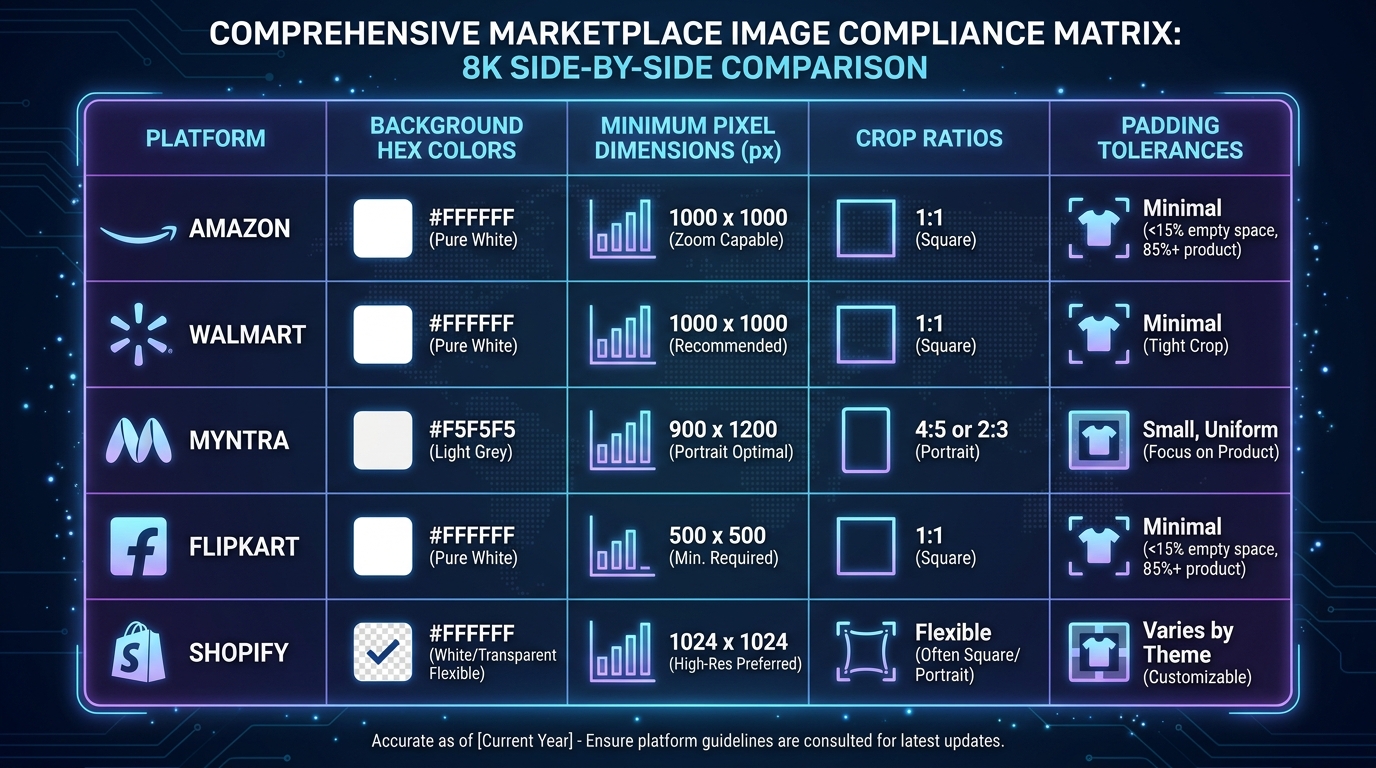
Review the conflicting technical requirements across five major e-commerce platforms:
| Platform | Required Background | Target Resolution | Subject Frame Fill | Critical Compliance Trap |
|---|---|---|---|---|
| Amazon (Main Hero) | Pure White RGB (255, 255, 255) | 1600x1600 to 2400x2400 | 85%+ of frame | Off-white / gray cast triggers silent search suppression |
| Walmart Marketplace | Pure White Seamless | 2000x2000 minimum | 80%+ of frame | Missing contact shadow flagged for 'floating item' review |
| Google Shopping (Merchant Center) | Solid Neutral / White | 800x800 minimum (1200px+ rec) | 75% – 90% frame | Text overlays, watermarks, or borders cause instant feed disapproval |
| TikTok Shop | High-contrast lifestyle / white | 1080x1920 (9:16 vertical) | Full vertical canvas | UI overlay collisions with checkout and profile buttons |
| Shopify Storefront Grid | Merchant brand choice (Clean white rec) | 2048x2048 for retina displays | Custom consistent padding | Inconsistent aspect ratios break category page alignments |
The 3-Step Automated Multi-Channel Pipeline
Rather than editing photos separately for each sales channel, modern catalog operations deploy a single ingestion workflow:
- Step 1: Single Master Packshot Ingestion: Upload one high-resolution product photo captured on a smartphone or digital camera. The AI separates the product into a clean, sub-pixel foreground layer.
- Step 2: Multi-Channel Profile Compilation: With a single click, the system compiles the master asset across Amazon (RGB 255 white, 85% fill, 2400px), Walmart (pure white with grounding umbra shadow), Google Shopping (unbranded clean packshot), and TikTok Shop (9:16 vertical canvas).
- Step 3: Algorithmic Pre-Flight Validation: Built-in computer vision validators check edge RGB values, calculate exact subject fill percentages, and flag potential compliance violations before syndication to ERP or PIM feeds.
Protecting Client Catalogs During High-Volume Drops
When an e-commerce brand launches 300 new SKUs for a seasonal drop, a single compliance error can lock up tens of thousands of dollars in unindexed inventory. Top agencies enforce these operational guardrails:
- Automated Barcode-to-Channel Renaming: Deliver files using platform-mandated taxonomy (e.g., `ASIN.MAIN.jpg` for Amazon and `SKU_primary.jpg` for Walmart) to prevent manual upload errors.
- Separation of Hero and Secondary Imagery: Keep main compliance images strictly sterile pure white, while allocating creative lifestyle staging to secondary gallery slots (slots 2 through 7) to maximize conversion.
- Quarterly Guideline Audits: Keep pace with evolving marketplace image specifications without rebuilding your internal tech stack.
What happens if an Amazon main product image is not pure RGB 255, 255, 255?
Amazon's automated image ingestion algorithm detects pixel deviation from pure white. If the background contains gray, blue, or yellow tints, the listing is automatically suppressed from search results, halting traffic.
Why does Google Merchant Center disapprove product images?
Google Shopping strictly prohibits promotional text overlays (e.g., '50% Off' or 'Free Shipping'), watermarks, borders, or low-resolution images. Listings with these violations are disapproved until compliant images are submitted.
Can one master photo be automatically formatted for Amazon, Walmart, and Shopify?
Yes. Using SocialShot's multi-marketplace profiles, you upload a single master photo and the engine automatically generates compliant versions with correct padding, resolution, and background codes for each channel.
Does Walmart allow contact shadows on white background product photos?
Yes. Walmart requires a pure white background but explicitly encourages natural, subtle contact shadows beneath the item to ground the product and prevent a flat, floating appearance.
How does image compliance impact organic marketplace ranking?
Marketplaces reward compliant, high-resolution images (2000px+) with higher organic search ranking and prominent category placement because clean images convert at higher rates.
Can agencies batch process compliance checks for hundreds of SKUs at once?
Yes. Agencies can upload bulk product archives or connect via API to generate and validate compliant multi-marketplace image packs for thousands of SKUs in minutes.
Automate Multi-Marketplace Compliance Across All Channels
Never risk listing suppression again. Generate 100% compliant, high-resolution image packs for Amazon, Walmart, Google Shopping, and TikTok Shop with SocialShot.