How Agencies Scale Creative Production: From Linear Bottlenecks to Exponential Output
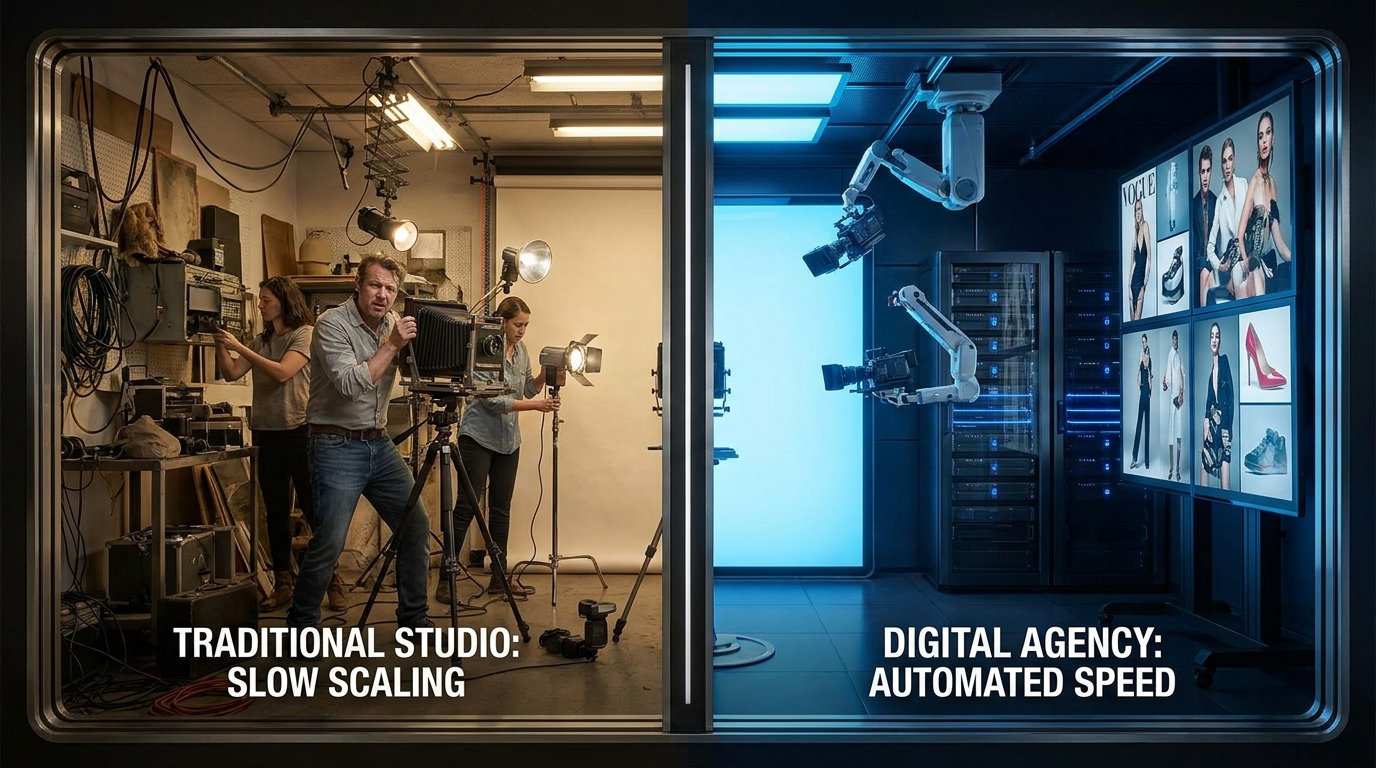
The Headcount Trap: Why Linear Agency Hiring Collapses
In standard agency operations, creative production is artisan and linear. A creative director writes a brief, a graphic designer creates three concepts in Figma or Photoshop, the client requests revisions, and a junior retoucher spends hours manually resizing those graphics into 1:1, 4:5, and 9:16 aspect ratios.
This artisan model breaks down under the demands of algorithmic media buying. Today, ad platforms like Meta Advantage+ and TikTok Smart Performance rely on machine learning that consumes and exhausts ad creatives every 10 to 14 days. If your agency can only produce four new creatives a month per client, your client's CPA spikes, ROAS drops, and client churn surges.
Scaling by hiring more designers is a financial death spiral: recruitment costs, salaries, software seat licenses, and managerial bloat erode agency profits. The only sustainable path is industrializing creative production through SocialShot for Agencies.
Comparing Agency Creative Capacity Scaling Models
Analyze how headcount-dependent agencies, template-based Canva/Figma shops, and AI-driven modular creative engines compare in capacity and economics:
| Scaling Metric | Headcount-Driven Agency | Template / Figma Automation | SocialShot AI Creative Engine |
|---|---|---|---|
| Monthly Asset Capacity per FTE | 40 – 60 finished assets | 100 – 150 assets (rigid templates) | 500 – 800+ bespoke assets |
| New Client Onboarding Time | 2 to 3 weeks (staffing search) | 5 to 7 days (template building) | Under 2 hours (brand kit setup) |
| Designer Burnout & Churn | High (Tedious manual resizing) | Moderate (Repetitive layout work) | Low (Designers focus on strategy & art) |
| Average Service Gross Margin | 28% – 38% | 45% – 55% | 75% – 88% |
| Visual Creative Diversity | Limited to physical photoshoot assets | Predictable, cookie-cutter look | Infinite global scenes, lighting, & models |
The 4-Stage Modular Creative Assembly Line
Top-tier creative agencies structure their production like an advanced manufacturing line, separating creative ideation from mechanical execution:
- Stage 1: Ingestion & Geometric Locking: Client packshots are automatically ingested, stripped of noisy backgrounds, and normalized to standard pixel boundaries while preserving packaging text and logo fidelity.
- Stage 2: Matrix Concept Generation: Media buyers select 5 high-converting psychological hooks (e.g., In-Situ Lifestyle, Luxury Pedestal, UGC Vanity, Problem/Solution Breakdown, and Seasonal Event) to generate 5 distinct conceptual directions simultaneously.
- Stage 3: Automated Generative Outpainting: The engine outpaints each concept into native aspect ratios—automatically generating canvas expansion for 4:5 mobile in-feed and 9:16 vertical Reels without stretching or cropping.
- Stage 4: Programmatic Testing Export: The finished creative stack is bundled into organized folders with standardized taxonomy, ready for immediate upload into Meta Dynamic Creative (DCT) ad sets.

Empowering Designers to Become Creative Directors
Adopting AI in an agency does not replace designers; it elevates them. When designers are liberated from spending six hours a day cutting out backgrounds with the Photoshop Pen tool or resizing banner dimensions, they transition into high-value strategic roles:
- Consumer Psychology Architecture: Developing sharper messaging angles, copy hooks, and visual contrast theories that grab attention in the first 1.5 seconds of social scrolling.
- Art Direction & Brand Guardrails: Curating bespoke aesthetic profiles, custom lighting moods, and proprietary brand model rosters that give clients a distinctive market presence.
- Creative Performance Analytics: Analyzing ROAS, CTR, and hook-rate data inside Meta Ads Manager to guide the next week's generative batching direction.
How does an agency scale creative output without hiring more designers?
By replacing manual photoshoot and retouching workflows with generative AI batching, a single designer can produce 500+ commercial-grade visual assets per month instead of the traditional 40 to 60 assets.
Will AI-generated creative look generic across different agency clients?
No. Enterprise tools like SocialShot allow agencies to establish custom brand kits, unique model personas, and proprietary lighting presets for each client, ensuring every brand maintains an exclusive, distinct visual identity.
How often should an agency refresh creative for a client spending $50k/month on ads?
On ad accounts spending $50,000 monthly, creative fatigue sets in within 7 to 10 days. Agencies should introduce 10 to 15 fresh creative variations weekly to maintain stable acquisition costs.
Can junior media buyers operate this creative workflow without design experience?
Yes. Intuitive preset-driven interfaces allow media buyers and account managers to generate multi-format ad variations directly from client packshots without requiring advanced Photoshop skills.
How does AI creative automation improve agency profitability?
By slashing per-asset production costs from $65+ down to under $0.30, agencies keep 75% to 85% of their creative retainer fees as pure gross profit while delivering significantly more value to clients.
Can agencies white-label AI creative deliverables to clients?
Yes. SocialShot allows agencies to share unbranded client approval portals, branded presentation decks, and clean export packages with zero third-party software attribution.
Scale Your Agency's Creative Output 10x Today
Stop letting manual resizing and slow photoshoots bottleneck your agency growth. Industrialize your creative production with SocialShot for Agencies.