Creative Testing for D2C Brands: The Scientific Framework for Scaling Paid Social in 2026
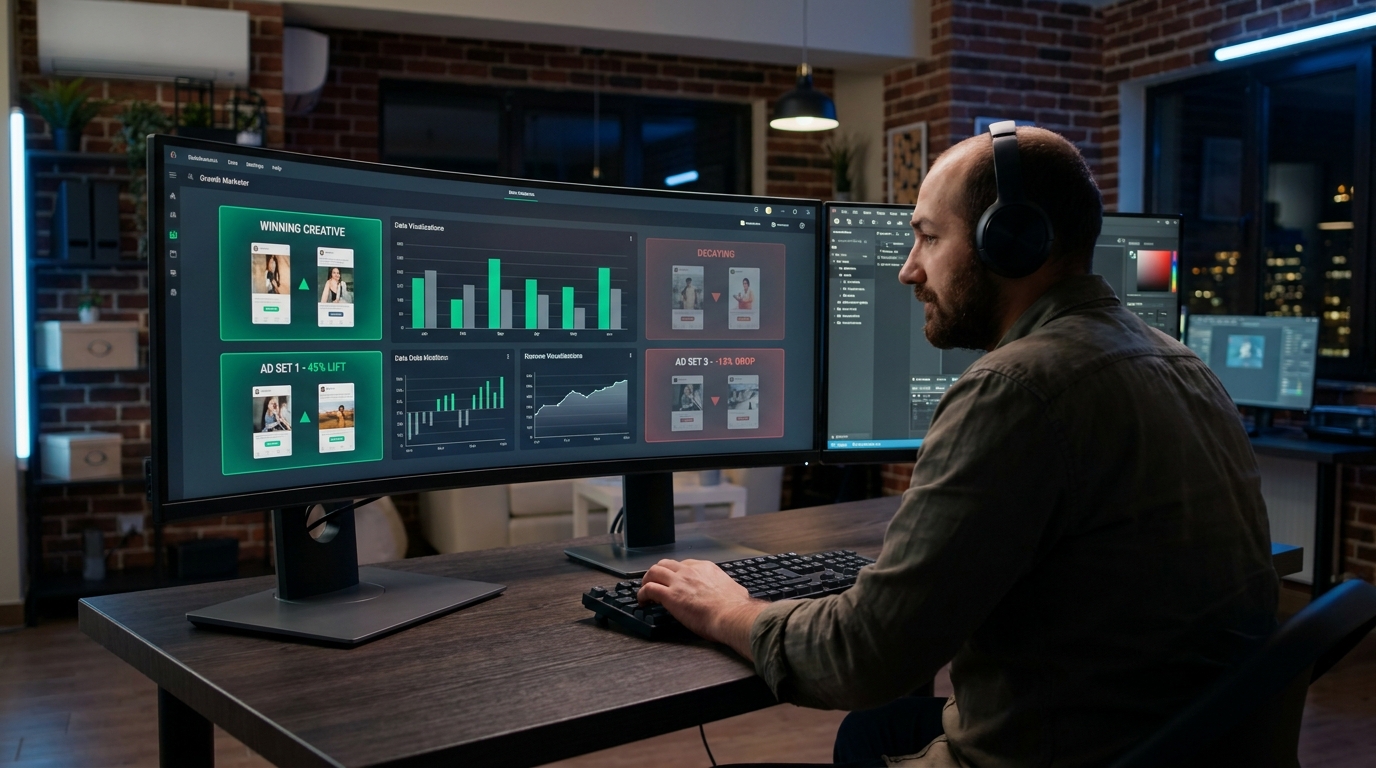
The Fatal Flaw in Unstructured Ad Testing
Most direct-to-consumer founders test ad creatives by launching five completely different ads—different images, different models, different headlines, different background environments, and different copy—all at once in a single ad set. When one ad generates purchases, they celebrate. But they have no idea why it worked.
Was it the headline? The model's demographic? The warm kitchen lighting? The 20% discount badge? Because multiple variables changed simultaneously, no scientific insight was gained. When that ad fatigues 10 days later, the team is back at square one, guessing what to build next.
Scientific creative testing treats advertising like a clinical laboratory: change only one variable at a time while holding all other elements constant.
The 3-Phase Creative Experimentation Hierarchy
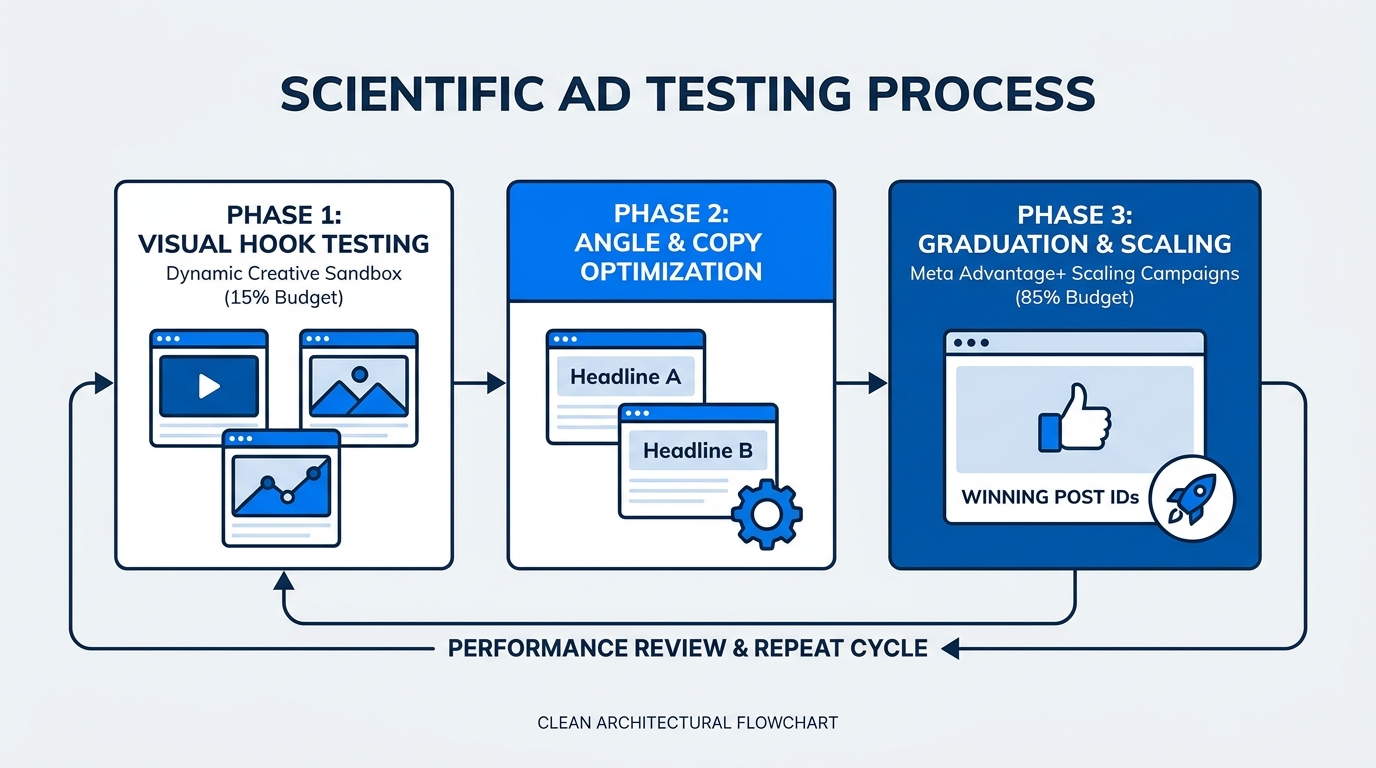
- Phase 1: Visual Hook Testing (Highest Leverage): The first 1.5 seconds or top 30% visual canvas dictates whether a user stops scrolling. Test 4 distinct visual hooks (e.g., Studio Pedestal vs Urban Street Style vs Bathroom Counter vs Macro Texture) with identical copy and headlines.
- Phase 2: Angle & Messaging Testing: Once a winning visual hook is identified, test 3 messaging angles on that visual: Problem/Solution ('Never iron your linen again') vs Social Proof ('Why 10,000 travelers made the switch') vs Value Comparison ('Luxury cashmere without the 5x markup').
- Phase 3: Format & Layout Iteration: Take the winning hook and messaging pair, and expand it into 4:5 vertical feed carousels, 9:16 Reels stills, and multi-product bundle layouts.
The Creative Testing Sandbox Campaign Architecture
| Campaign Component | Creative Sandbox (Testing) | Advantage+ Scaling (Production) | Operational Purpose |
|---|---|---|---|
| Budget Allocation | 15% – 20% of total spend | 80% – 85% of total spend | Controls testing financial risk |
| Bidding Strategy | Lowest Cost / Cost Cap sandbox | Advantage+ Shopping Campaign (ASC) | Protects scaling campaign stability |
| Ad Set Structure | Dynamic Creative (DCT: 3x2x2) | Proven winners only (post IDs) | Prevents premature budget cannibalization |
| Evaluation Metrics | Thumbstop Rate & Outbound CTR | Blended CPA and ROAS | Filters noise from true conversion intent |
| Graduation Threshold | 3x Break-even ROAS on 50+ clicks | Scaled to high budget volumes | Guarantees statistical significance |
The Scientific Testing Framework Flowchart
Here is the step-by-step workflow used by 8-figure D2C brands to graduate ad concepts from initial hypothesis to scaled production:
Using SocialShot's Social Campaign Studio, brands can generate all four test variations of a visual hook in under 3 minutes—ensuring lighting consistency, exact garment fidelity, and identical product placement across all experimental variants.
What percentage of monthly ad spend should be allocated to creative testing?
Most successful direct-to-consumer brands allocate between 15% and 20% of their total monthly ad budget toward dedicated creative testing sandboxes, reserving 80% to 85% for scaling proven winning creatives.
How many creative variations should I test each week?
For accounts spending $10,000 to $50,000 monthly, testing 5 to 10 distinct visual concepts per week is the ideal cadence. Testing fewer than 5 makes it difficult to overcome creative fatigue, while testing over 20 without sufficient budget leads to inconclusive data.
What is the graduation rule for moving a test ad into a scaling campaign?
A test ad should achieve at least 50 outbound clicks, maintain a Cost Per Acquisition (CPA) at or below your target threshold, and generate at least 5 to 10 purchases before being graduated into your main Advantage+ scaling campaign.
Why shouldn't I test new creatives directly inside an active Advantage+ campaign?
Advantage+ Shopping Campaigns (ASC) algorithmically bias delivery toward historical winners. New ads introduced directly into ASC often receive near-zero impressions or cause temporary performance volatility across the entire campaign.
What metric is most important when evaluating a top-of-funnel visual hook?
Thumbstop Rate (3-second video views divided by impressions for video) and Outbound Click-Through Rate (CTR) for static images are the most reliable early indicators of visual hook resonance.
How does AI accelerate creative testing cycles?
AI tools like SocialShot allow growth teams to formulate a visual hypothesis on Monday morning, generate 10 clean photographic variations in minutes, and launch the test sandbox before lunch, compressing traditional 3-week testing cycles into hours.
Build a Scalable Creative Testing Pipeline
Stop guessing what converts. Generate dozens of scientifically isolated ad creative variations from your existing catalog with SocialShot.