Consistent AI Models Across a Collection: The Secret to Cohesive Brand Lookbooks
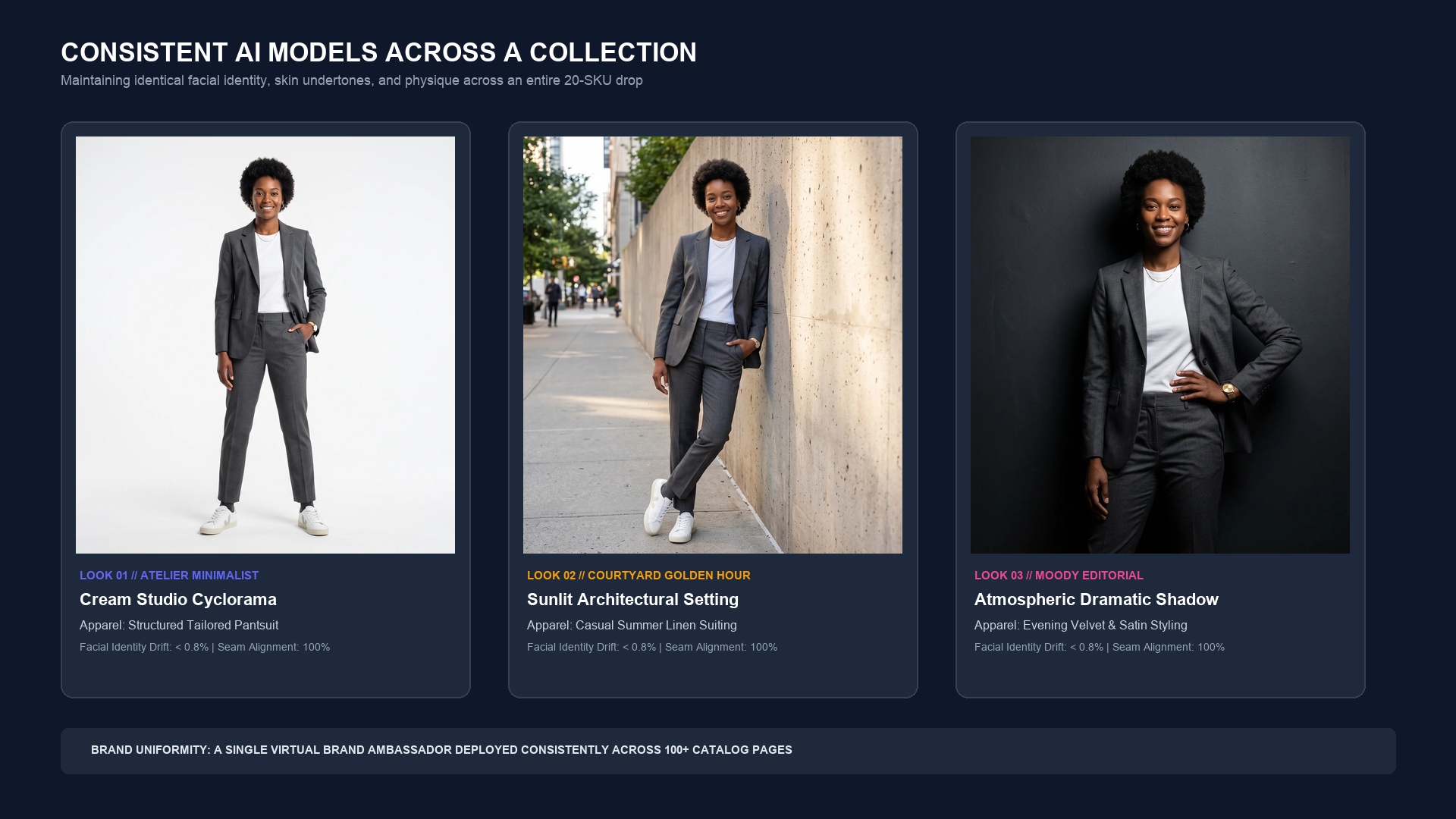
The 'Face Roulette' Trap: Why Inconsistent Models Erode Consumer Trust
When luxury shoppers browse a collection page—whether on Zara, Net-a-Porter, or a fast-growing D2C label—their eyes naturally seek visual cadence. They expect to see a cohesive casting board of 2 to 4 models recurring across blouses, trousers, blazers, and outerwear. This continuity establishes scale: if a shopper sees how a dress falls on 'Model Sarah,' seeing Sarah in a winter coat immediately communicates the comparative silhouette and fit.
When an ecommerce brand relies on naive text-to-image prompts without identity constraints, each generation produces a disconnected face. The product grid looks cluttered, erratic, and immediately recognizable as budget dropshipping. Consumer trust plummets, and shoppers question whether the physical garments even exist.
| Merchandising Approach | Catalog Visual Cohesion | Perceived Brand Value | Shopper Cart Abandonment | Production Scheduling Agility |
|---|---|---|---|---|
| Unconstrained Generative AI ('Face Roulette') | Disjointed: Every SKU features an unrelated face and physique | Low: Appears synthetic, untrustworthy, and generic | Elevated: Customers struggle to gauge garment sizing | Unpredictable: High rejection rate per generation batch |
| Traditional Physical Model Booking | High: Single model shot continuously over studio day | High: Professional high-fashion agency lookbook feel | Low: Consistent scale and fit references | Rigid: Requires 30-day advance booking, flight re-costs, illness risks |
| SocialShot Virtual Ambassador Architecture | Near 100%: Locked facial landmarks, height, and skin tones | Luxury Tier: Consistent editorial aesthetic across all categories | Lowest: Clear proportional continuity across all SKUs | Instant: Generate additions or restocks on-demand anytime |
The 4 Technical Pillars of AI Model Continuity
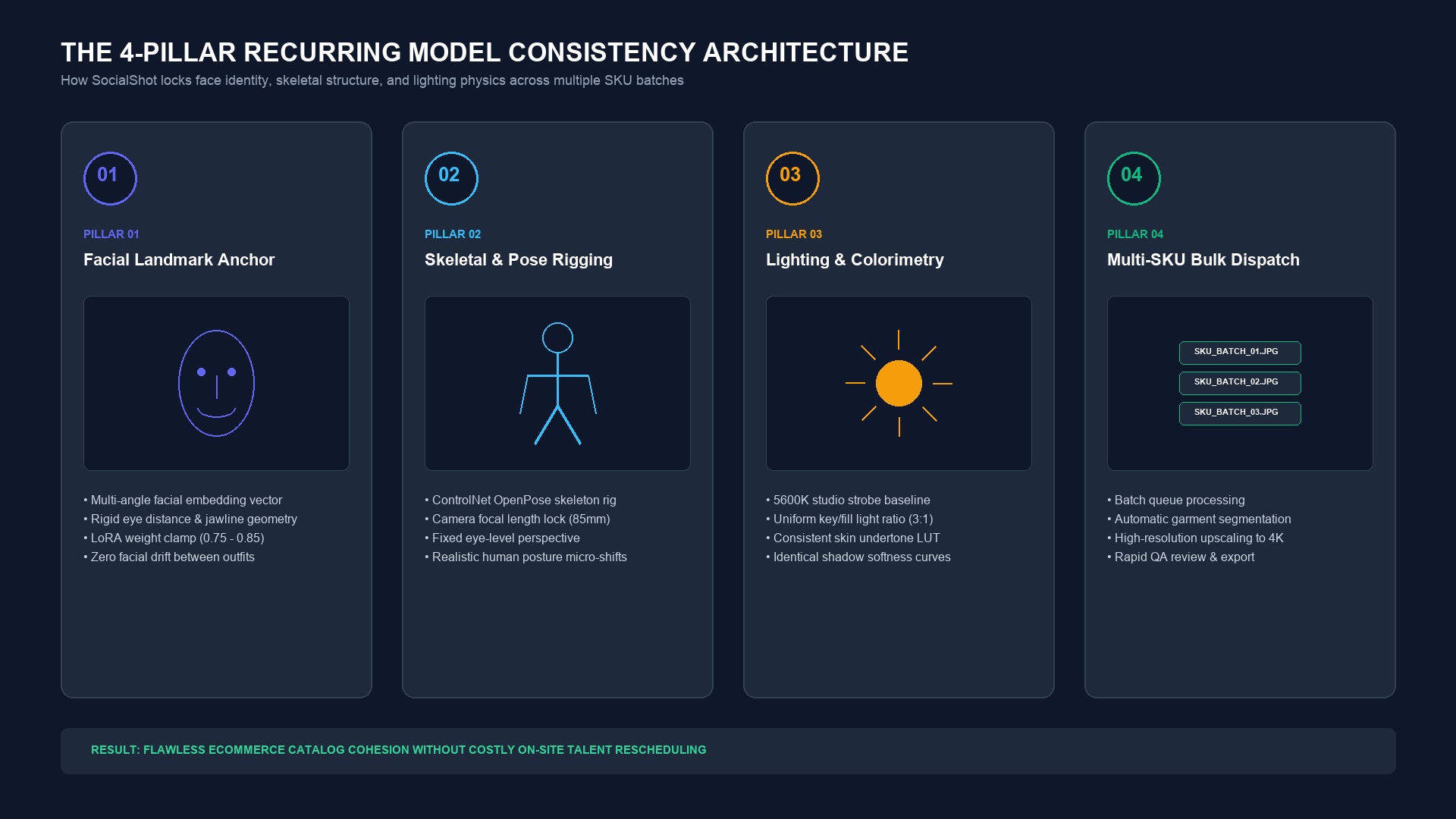
Maintaining model identity across different poses, lighting scenarios, and outfits is one of the most sophisticated tasks in modern computational photography. Achieving photographic continuity requires four locked technical anchors:
- 1. Facial Landmark Embeddings (LoRA & IP-Adapter): The model's bone structure, inter-pupillary distance, nose bridge contour, and jawline are encoded into an identity vector. This mathematical representation is held constant, preventing facial drift regardless of whether the model is smiling, turning, or wearing sunglasses.
- 2. Skeletal & Anatomical Rigging (ControlNet OpenPose): To prevent models from inexplicably gaining muscle mass or changing heights between a t-shirt shot and a jeans shot, anatomical proportions are tethered to a standardized skeleton rig. Shoulder width, torso length, and leg-to-body ratios remain mathematically static.
- 3. Studio Lighting & Colorimetry Lock: A model's skin undertone can shift wildly if the AI renders one shot under warm tungsten light and another under cold blue shadows. We enforce a calibrated 5600K studio strobe baseline with identical key-to-fill ratios, ensuring consistent undertones across all photos.
- 4. Multi-SKU Bulk Pipeline Dispatch: Rather than generating images one-by-one with manual prompts, the collection is ingested into SocialShot's Bulk Fashion Studio, applying the locked model profile across dozens of garments in a single automated queue.
Step-by-Step: Creating Your Brand's Virtual Model Ambassador
Ready to develop a permanent, proprietary face for your brand lookbooks? Follow this straightforward creation protocol:
- Define Your Casting Profile: Determine the demographic, age, height, and hair texture that resonates most with your core buyer persona. For a sleek minimalist label, this might be an athletic 5'10" model with clean, slicked-back dark hair. For an organic linen line, a model with relaxed natural curls and warm undertones.
- Generate and Lock the Master Seed: In SocialShot, generate initial model variations until you land on the ideal face. Once selected, save the identity to your brand workspace as a 'Custom Model Profile.'
- Establish Your Angle & Pose Board: Configure standard pose archetypes: Frontal Full-Length, Frontal Three-Quarter, Side Profile, and Back View. By locking these pose blueprints, every new garment in your line will be rendered with identical camera angles.
- Execute Test Batches Across Categories: Render the model wearing three contrasting garments—a structured blazer, a relaxed knit sweater, and a casual t-shirt. Verify that the model's physique, neck length, and posture look identical across all three.
Handling Edge Cases: Heavy Outerwear vs. Form-Fitting Apparel
A frequent pitfall occurs when transitioning between bulky garments (like a down puffer jacket or heavy wool coat) and close-fitting items (like swimwear or activewear). In raw generative tools, a model wearing a puffer jacket often appears physically larger, causing their face and hands to swell proportionally.
SocialShot prevents this by decoupling the anatomical skeletal volume from the garment layer volume. The underlying human frame remains exactly 5'10" and a standard size small; the puffiness of the outerwear expands outwards as physical garment thickness without distorting the model's true body proportions.
Building a Curated Model Roster (The 3-Model Rule)
While featuring one consistent model is a massive upgrade over random faces, high-performing fashion brands typically maintain a curated roster of three to five distinct virtual models. For instance:
- Model 1 (Primary Editorial Hero): Carries the core collection launches, homepage banners, and seasonal lookbook covers.
- Model 2 (Streetwear & Casual Variant): Merchandises athleisure, denim, and weekend casual drops with dynamic lifestyle posing.
- Model 3 (Curve & Inclusivity Lead): Merchandises the collection across mid-size and curve sizing, demonstrating authentic garment grading.
How does SocialShot guarantee the same model face across different poses?
We extract a high-dimensional facial landmark embedding from the master model profile. During image synthesis, this identity vector guides the latent diffusion process, locking the nose, eyes, mouth, and jawline geometry to match the source reference with sub-millimeter precision.
Can I use an existing real-life founder or brand model as the reference?
Yes. With authorized likeness rights, you can upload 5 to 10 reference photos of a real model or brand founder. SocialShot trains a dedicated identity model, allowing your real-life ambassador to appear in unlimited photoshoots without stepping foot in a studio.
Does model consistency work across different lighting environments?
Yes. The identity model captures structural bone features rather than baked-in pixel colors. Whether placed in a clean white studio cyclorama or an outdoor sunset patio, the model's facial structure remains identical while realistic environmental lighting naturally illuminates their features.
What happens if we re-order or add new SKUs six months later?
Your custom model profile is saved in your SocialShot workspace indefinitely. You can upload mid-season restocks or next season's line six months later and render the exact same model with zero visual deviation.
Can competitors copy or use my custom virtual model?
No. Custom model seeds and trained facial weights stored within your SocialShot brand dashboard are strictly private and isolated to your enterprise account.
How many garments can I render with the same model simultaneously?
There is no limit. Our batch generation engine can process 500+ SKUs across your consistent model roster in parallel.
Create Your Brand's Virtual Model Ambassador Today
Lock in an exclusive, cohesive model identity for your brand and render your entire collection with flawless lookbook continuity.
Last updated September 2026. Identity vector precision benchmarks measured using standard ArcFace and InsightFace cosine similarity evaluations.