How to Clean Up Supplier Product Photos: Turning Low-Grade Factory Shots into High-ROAS Visuals

The Supplier Photo Trap: Why Raw Factory Images Kill Margins
Factory product photos are shot for B2B wholesale documentation, not consumer conversion. A factory manager snaps photos on an old smartphone under flickering warehouse fluorescent tubes, leaving greasy fingerprints on packaging, harsh flash glare, and wrinkled fabric folds.
To make matters worse, Chinese manufacturers and wholesale agents frequently stamp heavy, semi-transparent watermarks, foreign language text badges, or measuring tape overlays directly across the center of the image.
When an online brand launches a store using these unedited supplier images, two disastrous things happen: first, Google Reverse Image Search allows shoppers to immediately locate the identical product on budget wholesale apps for 80% cheaper. Second, paid ad algorithms penalize the unpolished creative with sky-high CPMs, rendering paid acquisition unprofitable.
Common Supplier Photo Defects & Automated AI Remedies
Transforming factory assets requires systematically addressing the five most prevalent visual defects:
| Supplier Photo Defect | Visual & Commercial Impact | Legacy Manual Fix (Photoshop) | SocialShot AI Automated Solution |
|---|---|---|---|
| Factory Watermarks & Asian Text | Destroys brand credibility; screams dropshipping | 20 mins Clone Stamp & Content-Aware fill | Generative inpainting restores occluded textures in 3s |
| Fluorescent Green / Yellow Tint | Colors appear sickly; high return rates | Manual Curves, White Balance, & Hue tuning | Spectral white balance normalization |
| 600x600px Blurry JPEGs | Blocks marketplace zoom; pixelated on mobile | Bicubic blur scaling (blurry and soft) | 4K generative super-resolution reconstructs weave |
| Cluttered Factory Floor | Distracts shopper; looks like wholesale surplus | Tedious manual Pen Tool isolation | Sub-pixel alpha segmentation into studio backdrop |
| Harsh Direct Flash Glare | Blows out product labels; cheap plastic sheen | Complex frequency separation retouching | Specular highlight attenuation and re-lighting |
The 4-Step Factory Photo Rehabilitation Pipeline
Top direct-to-consumer brands use SocialShot's AI Photoshoot Studio to rehabilitate low-grade supplier catalogs into cohesive, high-ROAS marketing campaigns:
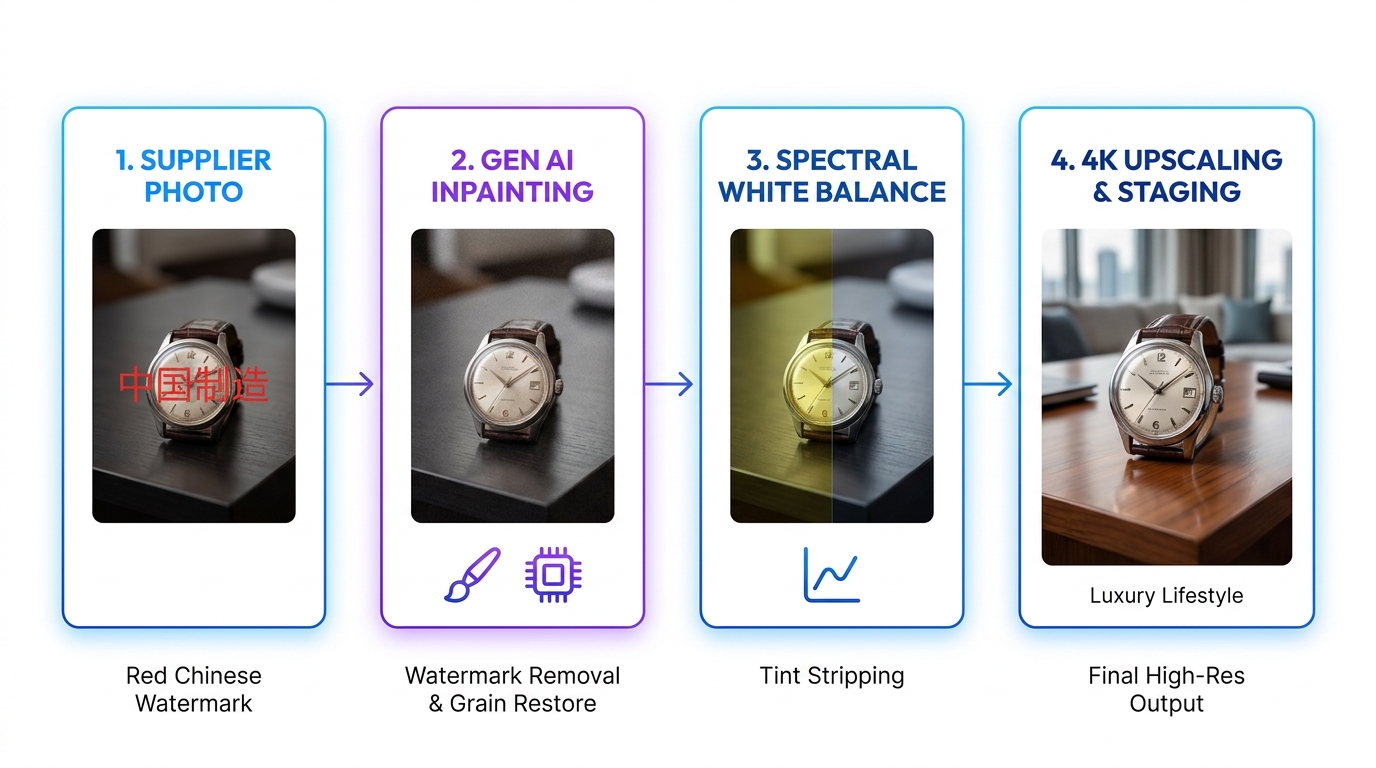
- Phase 1: Generative Watermark & Badge Inpainting: The system scans the image to identify foreign text overlays, supplier logos, and measuring arrows. A generative diffusion inpainting pass reconstructs the hidden product texture beneath the watermark, leaving zero trace of the original graphic.
- Phase 2: Color Temperature & Dynamic Range Normalization: Industrial fluorescent lighting casts a green-yellow tint across white surfaces. The engine detects neutral gray points, resets color balance to daylight (5500K), and recovers crushed shadow details.
- Phase 3: Neural Background Extraction: The product is cleanly extracted from the factory clutter using sub-pixel alpha matting, eliminating harsh edge halos and preserving fine details.
- Phase 4: Generative Staging & Super-Resolution Upscaling: The cleaned product is scaled to 4K resolution and placed onto a premium studio pedestal or contextual lifestyle scene with ray-traced contact shadows.
How Branded Supplier Visuals Multiply Enterprise Valuation
Upgrading your catalog imagery from generic supplier shots to bespoke branded visuals delivers measurable financial dividends beyond conversion rates:
- Higher Perceived Value & Pricing Power: Customers gladly pay a 30% to 50% premium for an identical SKU when presented in elegant editorial lifestyle staging compared to raw factory packaging.
- Insulation from Copycats: When your marketing assets are unique and customized to your brand aesthetic, competitors cannot easily scrape your images to run copycat campaigns.
- Wholesale & Retail Buyer Appeal: If you intend to pitch your brand to retail buyers at Target, Nordstrom, or Sephora, presenting polished, cohesive line sheets is mandatory.
Is it legal to use and edit supplier product photos?
Yes, provided you have a commercial relationship with the manufacturer or supplier and have purchased or licensed the rights to sell their inventory. Transforming factory photos into branded assets is standard ecommerce practice.
How does AI remove watermarks from supplier images without blurring the product?
Unlike traditional blur filters, generative AI inpainting analyzes the surrounding product context (such as leather grain, knit patterns, or metallic sheen) and synthesizes brand-new matching pixels in place of the watermark.
Can I clean up supplier photos that have Chinese or foreign text banners on them?
Yes. Generative inpainting easily detects and removes foreign characters, measurement callouts, and promo badges, restoring the clean product underneath.
Will cleaning up supplier photos protect my store from reverse image search?
Yes. By removing watermarks, correcting lighting, and placing the item into a unique AI-generated background, reverse image search engines will no longer match your product to the original Alibaba or 1688 wholesale listing.
How long does it take to clean up a supplier catalog of 100 SKUs?
Using SocialShot's automated batch workflow, an entire catalog of 100 supplier images can be watermarked-cleaned, color-corrected, upscaled, and placed into premium backgrounds in under 15 minutes.
What if the supplier photo has severe fabric wrinkles or stains?
Modern generative photography engines smooth out unnatural creasing and remove minor surface blemishes while preserving the authentic weave and material texture of the garment.
Transform Dirty Factory Shots into High-ROAS Assets
Stop letting low-grade supplier photos undermine your brand credibility. Erase watermarks, fix lighting, and upscale factory images in seconds with SocialShot.