Bulk Product Photography: How to Shoot & Edit 500+ SKUs Without Studio Bottlenecks
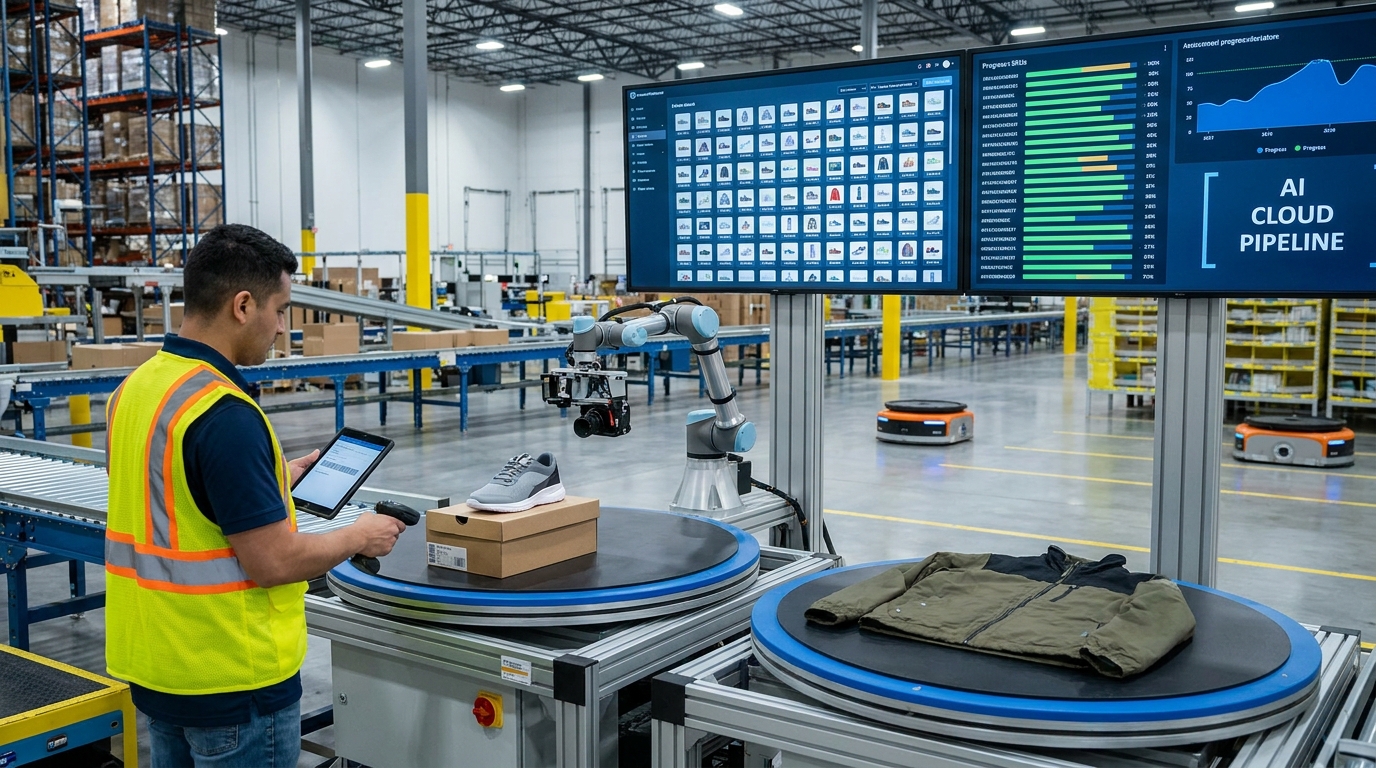
The High-Volume Crisis: Why Traditional Studios Fail at Scale
When an ecommerce brand manages 50 SKUs, booking a studio for two days each quarter is manageable. But when a brand scales to 500, 2,000, or 10,000 active SKUs with rapid inventory turnover, traditional commercial photography collapses under its own operational weight.
Traditional commercial studios operate linearly: sample unboxing, steaming, staging, physical lighting adjustment, shooting multiple angles, transferring SD cards, culling images, outsourcing clipping paths to offshore retouching teams, and manual file renaming. A single delay in the chain holds up millions of dollars in inventory from going live on storefronts.
Every day a new SKU sits in a fulfillment center waiting for photography, it generates zero revenue while incurring holding costs. Speed-to-market is no longer a creative metric; it is an inventory cash flow metric.
Comparing Production Models for 500-SKU Collections
To evaluate operational efficiency, consider how three different photography workflows handle a standard 500-SKU seasonal catalog intake:
| Production Vector | Traditional Studio Line | Automated Turntable Rig | SocialShot AI Cloud Batch Pipeline |
|---|---|---|---|
| Turnaround Time (500 SKUs) | 3 to 4 weeks | 7 to 10 days | 24 to 48 hours |
| Total Production Cost | $15,000 – $25,000 ($30–$50/SKU) | $6,000 – $9,000 ($12–$18/SKU) | $250 – $600 ($0.50–$1.20/SKU) |
| Hardware Capital Expense | None (Studio rental fees) | $15,000 – $35,000 motorized booth | $0 (Standard smartphones/existing cameras) |
| Labor & Headcount | Photographer, stylist, assistant, retoucher | Dedicated machine operator | Single warehouse intake clerk |
| Visual Asset Diversity | Limited to 2–3 physical sets | Strictly 360 spin or pure white | Infinite studio, lifestyle, and on-model variations |
The 5 Operational Bottlenecks of Bulk Product Photography
High-volume visual operations break down at specific transition points. Recognizing these traps is the first step to building an automated pipeline:
- Physical Sample Preparation: Unboxing, de-tagging, ironing, and styling garments or positioning bottles consumes up to 60% of studio time. AI workflows allow minimal physical styling, correcting wrinkles and minor scuffs during generation.
- Strobe Lighting Drift: Across a 4-day studio shoot, ambient temperature shifts, light bulb degradation, and accidental tripod bumps create subtle color temperature and brightness variations between batch #1 and batch #500.
- Offshore Retouching Latency: Sending 2,000 images to overseas retouching farms introduces 24-to-72-hour feedback loops, recurring revisions, and security risks with unreleased product IP.
- Manual File Renaming & SKU Mapping: Nothing derails an enterprise launch faster than retouchers returning filenames like `IMG_4092_final_v2.jpg` instead of the required barcode `SKU-8942-01.jpg`.
- Multi-Channel Format Fragmentation: Re-sizing and cropping 500 products into 1:1 Amazon squares, 4:5 Shopify verticals, and 9:16 social formats manually demands hundreds of designer hours.
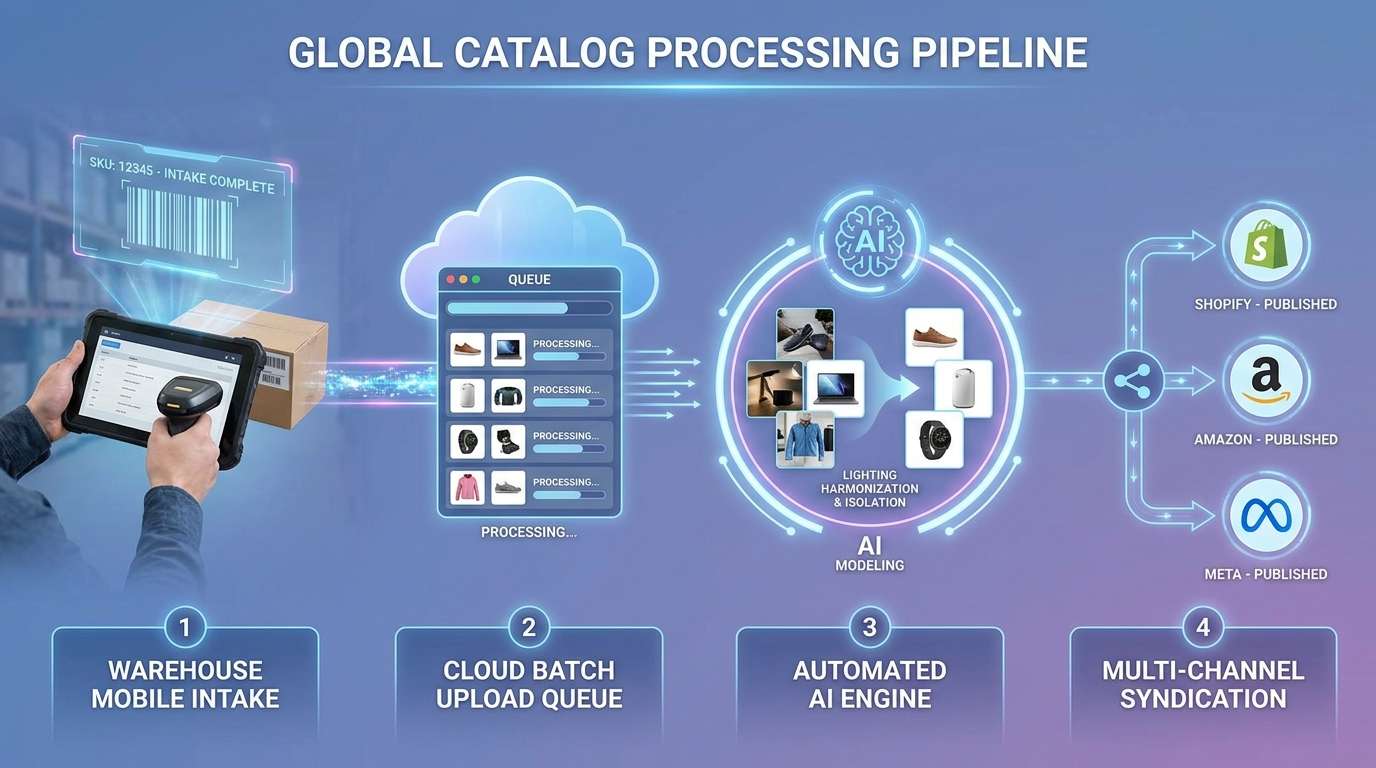
The Modern Bulk AI Production Blueprint
Forward-thinking retailers use SocialShot's Agency & Enterprise Suite to build high-speed intake pipelines directly inside their receiving docks:
- Standardized Mobile Intake: Warehouse staff photograph items on a basic light table or tabletop using an iPhone or iPad immediately upon barcode scanning.
- Cloud Batch Upload: Photos are uploaded concurrently via CSV manifest or direct folder drag-and-drop, preserving SKU numbers as canonical file identifiers.
- Synchronized Multi-Scene Processing: The AI batch engine strips backgrounds, standardizes RGB 255 pure white backdrops for main images, and generates 3 lifestyle scenes per SKU in parallel.
- Automated Multi-Channel CDN Export: Completed assets are automatically delivered into organized folders formatted for Amazon, Shopify, Google Merchant Center, and TikTok Shop.
What is bulk product photography?
Bulk product photography is the process of capturing, editing, and formatting visual assets for large volumes of inventory (hundreds or thousands of SKUs) using standardized workflows and automated batch technologies.
How many product photos can AI process at once?
Platforms like SocialShot are engineered for enterprise scale, capable of processing hundreds of high-resolution product images simultaneously through cloud-distributed AI worker queues.
Can warehouse workers operate an AI photography pipeline?
Yes. Because modern AI handles subject segmentation, lighting harmonization, and background replacement automatically, warehouse intake staff only need to take simple, in-focus photos with a standard smartphone.
How does bulk AI photography maintain catalog consistency?
By applying unified style presets (such as matching lighting angles, shadow intensity, and backdrop color palettes) globally across all uploaded assets, AI ensures 100% visual uniformity across every SKU.
Can I automatically name exported files with my internal SKU codes?
Yes. SocialShot allows file preservation based on source file naming or CSV mapping, ensuring that exported files automatically match your ERP or Shopify SKU nomenclature.
How much money can a brand save by switching to bulk AI photography?
Brands typically reduce their photography expenditures by 85% to 95%. A catalog of 500 SKUs that previously cost $15,000+ in studio fees can be completed for under $500 with AI automation.
Scale Your Entire Catalog with AI Batching
Eliminate studio scheduling delays and cut visual production costs by 90%. Shoot and deploy hundreds of production-ready product images in hours with SocialShot.