AI Photoshoots for Dresses, Shirts, T-Shirts, Jeans, Jackets, Tops, Activewear, and Ethnic Wear
Why Generic AI Prompting Fails in Fashion Merchandising
Most disappointing AI fashion images suffer from a single root cause: fabric weight amnesia. When an algorithm does not understand whether a textile is rigid wool or liquid modal jersey, it tends to average everything toward a generic, rubbery synthetic look. Tailored jackets lose their shoulder structure, button-down collars collapse onto the chest, denim looks like painted spandex, and silk loses its fluid, liquid gravity cascade.
To produce commercial-grade ecommerce imagery that drives sales and minimizes returns, your visual pipeline must respect the unique textile construction, weave density, and anatomical drape of each garment class.
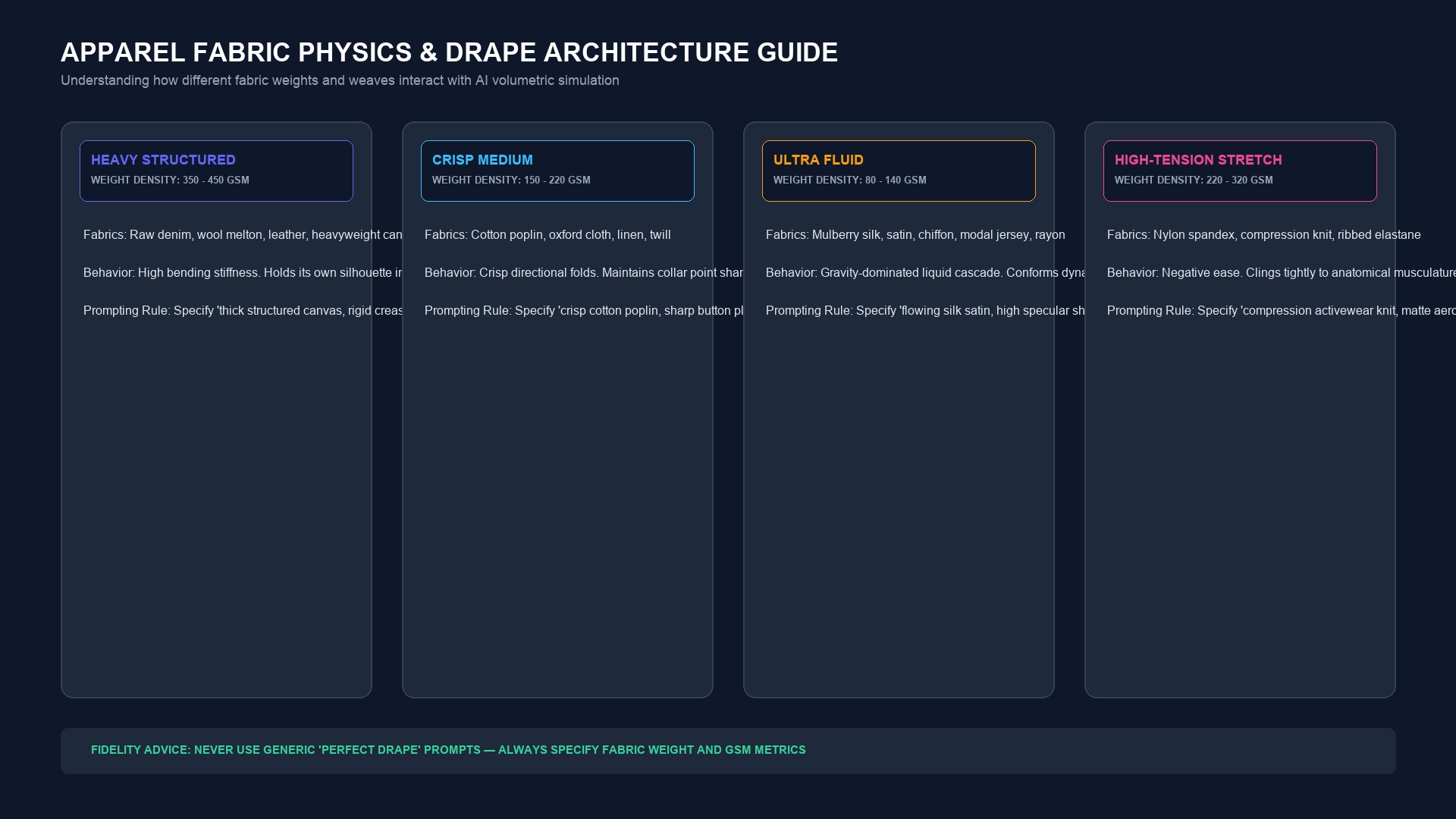
| Garment Category | Fabric Density (GSM) | Drape Characteristic | Primary Physical Anchor | Lighting Priority |
|---|---|---|---|---|
| Tailored Jackets & Blazers | 300 – 450 GSM (Wool/Blend) | Rigid, self-supporting silhouette | Shoulder pad roll & lapel crease | Subtle directional key for lapel shadow |
| Button-Down Shirts | 120 – 180 GSM (Poplin/Oxford) | Semi-crisp with sharp directional folds | Collar stand stiffness & button placket | Clean high-key fill to prevent button flare |
| T-Shirts & Tops | 160 – 240 GSM (Combed Cotton/Jersey) | Natural vertical drop with soft folds | Ribbed crewneck tension & sleeve hem | Soft diffuse ambient to reveal weave texture |
| Jeans & Denim | 340 – 450 GSM (Raw/Twill Denim) | High bending stiffness, rigid stacking | Inseam tension & authentic knee break | Cross-grazing raking light to accent twill weave |
| Dresses & Eveningwear | 80 – 140 GSM (Silk/Satin/Rayon) | Gravity cascade, bias drape, fluid motion | Waistline gather & hemline movement | Specular highlight tracking for silk sheen |
| Activewear & Athleisure | 220 – 320 GSM (Nylon Elastane) | Negative ease compression, zero slack | Muscular contour cling & flatlock seams | Rim edge lighting to define athletic silhouette |
| Ethnic Wear (Sarees/Kurtas) | 90 – 350 GSM (Brocade/Silk/Georgette) | Volumetric cascading pleats & pallu drop | Shoulder pleat pinning & border alignment | Warm directional strobe for zari/gold thread |
Category Deep Dive: Technical Drape & Lighting Protocols
1. Tailored Jackets, Coats, and Blazers
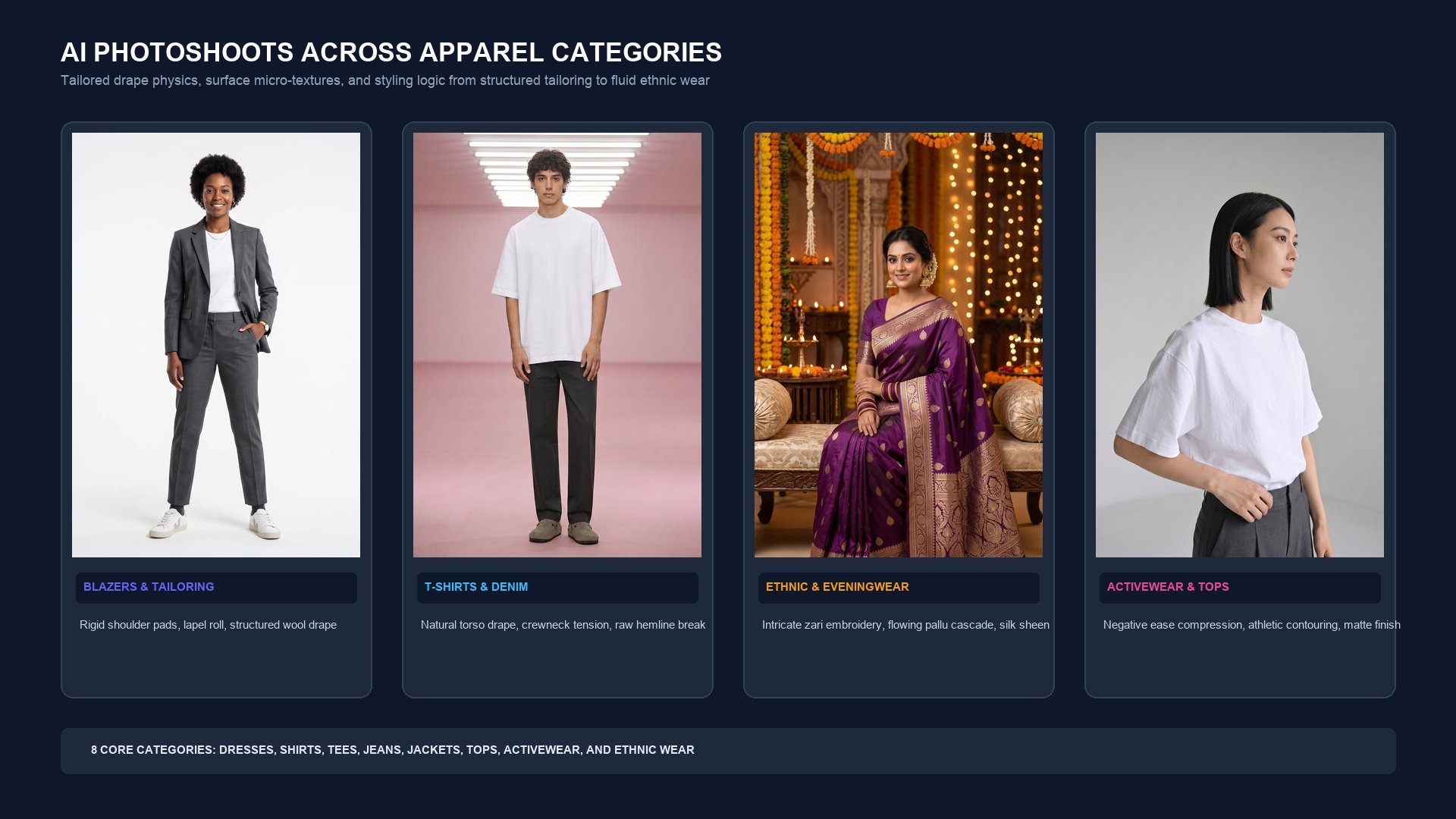
Suits and coats rely on internal architecture—canvas interlining, shoulder pads, and chest felts. If an AI model sags the shoulder seams or curves the lapels inwards like a sweater, the garment looks poorly tailored and cheap. In SocialShot, tailoring templates enforce rigid shoulder apex coordinates and preserve the crisp 90-degree lapel roll.
2. Button-Down Shirts and Blouses
The hallmark of a crisp poplin or oxford shirt is the collar stand. Collars must remain elevated around the neck without collapsing or clipping into the model's collarbones. Plackets must remain straight and vertical, without the wavy distortion common in amateur image generation.
3. T-Shirts, Polos, and Casual Tops
Casual jersey garments require natural, relaxed gravity. A heavyweight 240 GSM streetwear tee should hang vertically from the chest with slight boxy structure, while a 140 GSM tri-blend tee should drape softly over the model's torso. Ribbed collar bands must lie flat without puckering.
4. Jeans and Denim Trousers
Denim is one of the hardest categories for AI because real denim has dimensional thickness. Cheap AI outputs make jeans look like blue leggings. SocialShot incorporates diagonal twill texture preservation and simulates authentic fabric stacking at the ankle cuff and knee whiskers.
5. Dresses and Flowing Eveningwear
Fluid garments require dynamic posing. Stiff standing poses make silk and satin look flat. Utilizing walking, turning, or seated poses allows the AI drape engine to calculate realistic bias-cut ripples, slit openings, and skirt flares that showcase the garment's kinetic beauty.
6. High-Performance Activewear
Activewear is designed with 'negative ease'—meaning the garment's cut dimensions are smaller than the body, relying on elastane stretch to hug muscle groups. The visual model must exhibit authentic athletic muscle definition without fabric wrinkles in high-compression zones.
7. Intricate Ethnic Wear (Sarees, Kurtas, Lehengas)
Traditional ethnic garments feature complex draping mechanics: unstitched saree fabrics draped over petticoats, structured pleated pallus pinned over shoulders, and metallic zari borders. Capturing these styles requires culturally trained volumetric rigs that preserve delicate border motifs and shimmering gold/silver embroidery.
Optimizing Lighting by Garment Finish
Different fabrics react distinctively to studio illumination. To prevent blown-out highlights or murky shadows, calibrate your lighting prompts to the fabric's surface reflectivity:
- Matte Textiles (Wool, Raw Cotton, Fleece): Benefit from directional key lighting with soft fill. Subtle cast shadows are essential to reveal the tactile depth of the knit or weave.
- High-Luster Textiles (Silk, Satin, Velvet): Require large diffuse softboxes or bounced ambient light. Sharp point lights cause blown-out white glares that obscure the true fabric color.
- Textured Weaves (Denim, Corduroy, Tweed): Benefit from raking side lighting (cross-lighting) angled at 45 degrees, which casts micro-shadows into the grooves, highlighting garment quality.
How does SocialShot handle intricate patterns like floral prints or plaids across categories?
We utilize texture-preserving semantic locks. The original 2D pattern is mapped along 3D contour normals rather than stretched arbitrarily, ensuring plaid lines and print motifs bend naturally around body curves without distorting.
Can I generate photoshoots for multi-piece outfits (e.g. jacket, shirt, and jeans together)?
Yes. Our layering engine allows you to upload multiple individual garment cutouts and composite them onto a single model with realistic layer occlusion (e.g., the jacket sits outside the shirt, which is tucked into the jeans).
What is the best way to photograph activewear before AI generation?
Shoot the activewear on a flat surface or plastic torso form with clear lighting on the seams and logo placements. Clean separation of the waistbands and hems guarantees crisp boundary detection.
Does AI handle heavy winter parkas and puffer jackets realistically?
Yes. Our volumetric outerwear pipeline calculates external loft and baffle thickness, rendering authentic down-filled bulk without expanding the model's actual human proportions.
How does the platform ensure embroidery in ethnic wear doesn't look flat?
We isolate the metallic and raised embroidery threads on a dedicated specular normal pass, ensuring that studio lights reflect off gold and silver zari with genuine metallic luster.
Can I mix and match different category poses in a single bulk batch?
Yes. When submitting a batch in the Bulk Fashion Studio, you can assign category tags (e.g., Denim, Suiting, Activewear), and the engine automatically applies the appropriate pose logic and drape physics.
Elevate Your Apparel Photography Across Every Category
Generate studio-grade, fabric-accurate on-model fashion photography tailored specifically to your exact garment types.
Last updated September 2026. Fabric GSM specifications and drape parameters referenced from ASTM International textile standards.