Building Consistent Brand Models Across Every SKU and Colorway
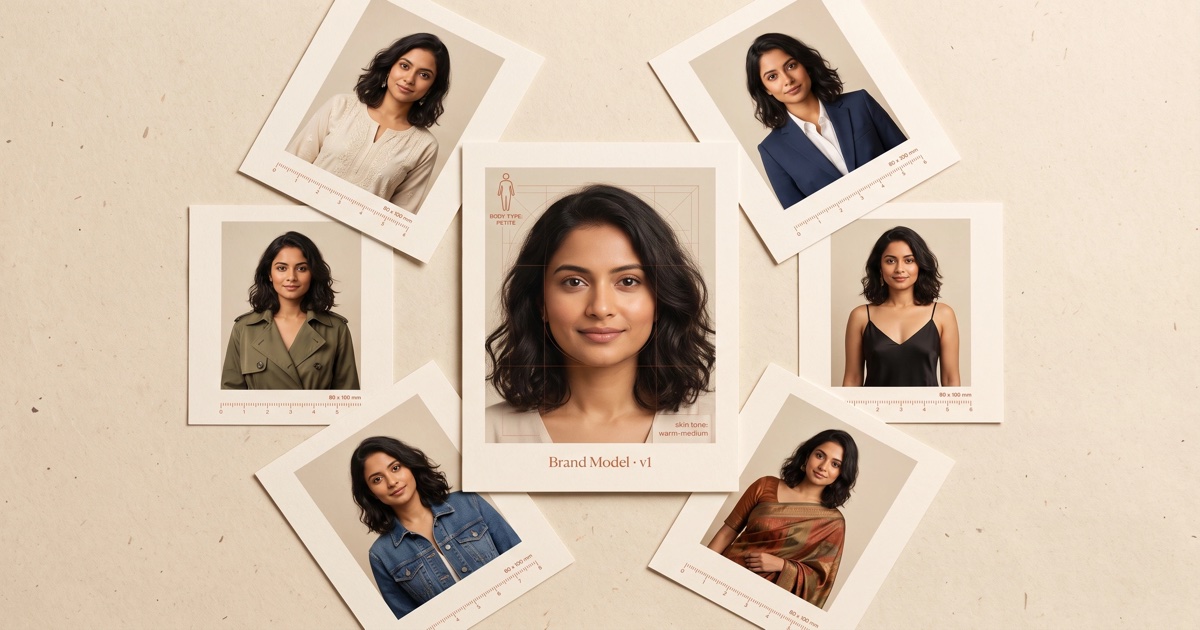
Walk through a typical Shopify catalog with the audit lens on, and you find something most founders haven't noticed: the model in the kurta image is not the model in the dress image, who is not the model in the jacket image. The lookbook used a different woman. The Instagram Reel used a third. None of this was a decision — it was a sequence of bookings that drifted across two years.
That drift is the single quietest reason a brand "feels generic." A customer scrolling through your PDPs gets no continuity of identity. Compare with the brands that nail it — Everlane, Khaite, Suta — where the same face quietly recurs and a customer's eye learns the brand within four images.
This post is about how to fix this cheaply, using identity-locked AI generation, and where the approach intentionally bends.
Why mixed-model catalogs underperform
We pulled session data from 38 DTC apparel brands in our cohort (Q1 2026) and compared single-model PDP series vs. mixed-model PDP series holding everything else constant — category, price band, traffic source.
| Metric | Single-model catalog | Mixed-model catalog |
|---|---|---|
| Add-to-cart rate | 4.2% | 3.4% |
| PDP bounce rate | 38% | 47% |
| Average session depth | 4.8 PDPs | 3.1 PDPs |
| Returning-visitor recognition (branded search 30 days later) | 22% | 13% |
The mechanism is straightforward: a recurring face is a brand cue. The first three times a customer sees the same model, she becomes "the brand's model" — even if the customer can't name her. That recognition shaves a fraction of a second off every scroll decision in the customer's future, which compounds.
The four dimensions of model identity
"Locking a model" is not just "use the same person." It is locking four things that read as identity to the human eye, in roughly this order of importance:
- Face geometry. The arrangement of eyes, brow, jaw, nose. The single strongest recognition signal. Two photos of the same person under different lighting will still register as the same person to the viewer if face geometry is preserved.
- Body type. Height, shoulder width, torso ratio, hip-to-waist ratio. A change here breaks identity even with the same face.
- Skin tone (lighting-corrected). Not just hue, but undertone. Cool vs. warm undertone is the second-strongest cue a customer reads after face geometry.
- Styling fingerprint. Hair texture/length, makeup approach, even how the model holds her hands. This is what professional creative directors lock without being able to articulate why; it's the gestalt above the four locks.
All four must hold for the catalog to feel cohesive. Locking three out of four is worse than not trying — the brain notices the mismatch and reads it as "low effort."
How AI brand models lock identity
Traditional photography locks identity by booking the same human across shoots — which is logistically expensive and gates your catalog cadence on her calendar.
AI brand models solve the same problem differently. A model identity is encoded as a reusable conditioning signal: a learned representation of face, body, and skin tone that the generation pipeline applies on every image. The output is generated against the actual garment (see Product Fidelity in AI Generation) and against the locked identity, so neither drifts.
In practice this means: cast your model identity once, then run 5,000 SKUs through her without rebooking, retraining, or rescheduling. The garment is the variable. The model is the constant.
SocialShot's Brand Models workflow exposes this as a single-step setup: choose a starting identity (custom or from the stock identity library), confirm body/face/skin lock, then reuse on every subsequent generation. The lock persists across sessions, ad campaigns, and PDP imagery automatically.
How to "cast" your brand model
A real casting decision, not a default. The three questions to answer before locking an identity:
- Who is your highest-LTV customer cluster? Pull your Shopify or Amazon data, find the age bracket and size cluster of your top 20% by repeat purchase. The model should be within one standard deviation of that cluster — same age range, body type proximity, regional fit. This is the "model = customer" pattern from the Meta Ad Creative cohort data.
- What is the brand's emotional register? Aspirational-luxury, accessible-everyday, playful-streetwear. The model's expression, posture, and energy should match. Don't pick a runway-cool face for a warm, lifestyle-DTC brand.
- Will you be in this category for 18+ months? Identity locks compound. The longer you keep the same model, the more recognition you accrue. Don't cast assuming you'll re-cast in 6 months — that defeats the lift.
For most brands, the right answer is a single identity. Some categories — for example, kidswear ranges that span infant-to-teen, or unisex lines — genuinely need 2–3 identities. The rule there is: lock a set of identities and use them consistently, never one-offs.
The 5-step lock playbook
| Step | What you do | Time |
|---|---|---|
| 1 | Audit your existing catalog. List every distinct model across PDPs, lookbooks, ads, and social. Most brands find 6–12. | 30 min |
| 2 | Pull your top-20% LTV customer profile. Note age cluster, body cluster, regional cluster. | 30 min |
| 3 | In Brand Models, generate 4–6 candidate identities matching the profile. Run each through 3 garment looks. | 1 hour |
| 4 | Pick the identity. Lock the four dimensions. Save it as the brand's default. | 15 min |
| 5 | Regenerate your existing PDP hero imagery against the locked identity. Old reshoots can wait — the new SKUs land on this identity from now on. | 2–4 hours per 100 SKUs |
The full migration of an existing catalog takes a week. The new-SKU forward-look pays for itself within 30 days because every new PDP and ad creative draws from the same identity automatically.
Multi-model brands — when one identity isn't enough
Three legitimate reasons to lock more than one identity:
- Multi-category brands. A brand selling womenswear and menswear needs at least two. A brand spanning kids' / women's / men's needs three plus a kid set.
- Plus-size inclusive ranges. If your range spans XS–6XL, locking one body type misrepresents the fit at the ends. The honest answer is to lock 2–3 identities at different body types and assign each to its representative size range on the PDP.
- Regional rollouts. A brand selling cross-border into both India and the US may benefit from one model per region. This is a deliberate, measurable decision — A/B test before committing.
In all three cases the rule is: lock a small, named set, and never deviate. The failure mode is "a different model per SKU because the merchandiser felt like mixing it up." That is exactly the drift you are trying to eliminate.
Where this approach falls short
We are honest about three places where a locked AI model identity is not the right answer:
- Founder-led brand storytelling. When the founder is the model, that is the asset. AI is the wrong tool.
- Real-customer UGC. A locked AI identity has no place in an actual customer testimonial section. Different content category, different rules.
- Cause / lifestyle campaigns featuring real people. If the message is about real customers, real activists, real employees — use real people.
The PDP and ad-creative volume that makes up 80% of your catalog imagery is the right surface for the locked identity. The remaining 20% intentionally stays human.
Get started
Audit your current catalog this week — most founders find 8+ models without realizing it. Then lock one identity in Brand Models and migrate new SKUs forward. See pricing for the per-image cost on regeneration.
FAQ
Will customers notice the model isn't a real person?
On a PDP, almost never — they're focused on the garment. On a lifestyle Reel with close-up emotional cuts, a few will. As of mid-2026, no brand has reported negative engagement directly attributable to AI brand models on PDPs; ad creative is the same. Disclose AI in influencer/editorial content per ASCI (India) and FTC (US) guidelines.
Can I use a real model's likeness?
Only with a signed digital-twin agreement that grants rights to AI replication of her likeness. Some agencies now offer this; the rates are typically a one-time fee plus a per-image royalty. Without that contract, do not replicate a real person — it's a legal risk and a moral one.
How does this work with multiple colorways of the same SKU?
The garment-conditioned pipeline (see Product Fidelity in AI Generation) treats each colorway as a separate garment input but holds the model identity constant. You get one model, every colorway, in any pose.
Does it work across seasons (summer dresses vs. winter coats)?
Yes — the model identity is independent of the styling. You can put her in a summer dress in a sunlit scene and a wool coat in a winter scene, same face, same body, different garment + scene.
How do I A/B test "does my customer prefer model X or Y"?
Run both identities in parallel ad creative for two weeks with the same SKU. Look at CTR and ROAS. The winner gets the catalog lock. Most brands find the answer in 5,000–8,000 impressions.
Last updated: 28 June 2026. We refresh the cohort comparison numbers each quarter.