Product Fidelity in AI Generation: Why What You Upload Must Be What Ships
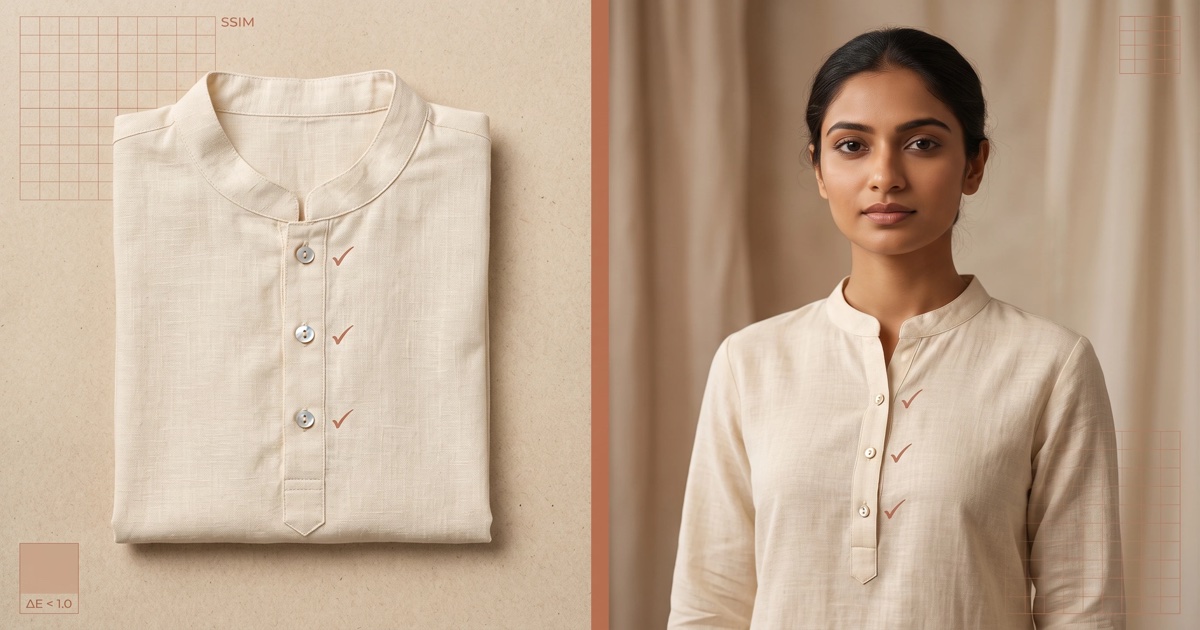
The complaint we hear most often from fashion brands evaluating AI photography is some variant of: "It's beautiful, but it's not my product anymore." The dress has the wrong neckline. The shoe has three eyelets instead of four. The print, which was a tight micro-floral on the flat-lay, now reads as a generic paisley. The customer who orders that dress gets the original — and writes a one-star review about the bait-and-switch.
This problem — product drift — is what kept AI fashion imagery out of the catalog mainstream until 2025. It is also the problem the latest generation of garment-conditioned pipelines now solves at production-grade reliability. This post walks through what changed.
The seven failure modes of product drift
In our internal benchmark across 12,000 garment generations (Q4 2025 – Q1 2026), every failure we logged collapsed into one of seven categories:
| Failure mode | Description | Frequency on text-prompted baseline | Frequency on garment-conditioned pipeline |
|---|---|---|---|
| Print drift | Pattern repeat changes scale, orientation, or motif | 22.1% | 0.8% |
| Trim miscount | Buttons, eyelets, snaps, zips — wrong count or placement | 18.6% | 1.1% |
| Color shift | ΔE > 3 vs. source garment | 14.3% | 0.6% |
| Drape error | Fabric reads as the wrong weight (silk as denim, linen as polyester) | 11.7% | 1.4% |
| Silhouette drift | Hemline, sleeve length, fit moves off-spec | 9.2% | 0.7% |
| Hardware fabrication | Zip pulls, buckles, logo plates get invented or replaced | 8.4% | 0.3% |
| Texture invention | Fabric grain becomes plausible but wrong (slubbed cotton becomes flat poplin) | 6.8% | 1.2% |
The pattern is consistent: text-prompted generation fails at the product, because the product is described in words and words underspecify a garment. Garment-conditioned generation fails roughly 20× less often on the same garments, because the garment itself is the input.
Why text prompts fail
If you describe a kurta in text — "a cream linen kurta with a v-neck, three-quarter sleeves, and a small chest pocket" — the model has to invent everything the description omits. How is the v cut? Where exactly does the pocket sit? What does "cream" mean in CIELAB? The model fills in plausible defaults. The defaults are not your product.
Even with elaborate prompts (200+ words), text-prompted generation cannot specify the things that actually matter: the exact print repeat, the actual button count, the precise placket geometry. A photograph specifies all of this in pixels. A prompt cannot.
What garment-conditioned generation does differently
A garment-conditioned pipeline inverts the input hierarchy. Instead of: "generate a photo of a model wearing a kurta described as follows…", the system is told: "here is an exact photograph of the kurta; generate a photo of a model wearing this specific garment, with the model and scene as the only variables."
Technically, this means the garment image is encoded into a control signal that conditions every step of the diffusion process. The model is structurally prevented from re-imagining the garment — the loss function penalizes any output where the rendered garment diverges from the source in print, trim, silhouette, or color.
The model is free to choose the model, the pose, the lighting, the scene, the camera angle. It is not free to choose how many buttons the shirt has.
The four-stage fidelity pipeline
SocialShot's pipeline (the one powering Product Photoshoot and Brand Models) runs every image through four stages before it returns to the user.
Stage 1 — Garment ingest
The input flat-lay is normalized: background segmentation, white-balance correction, perspective de-skew, and fabric-class detection (woven vs. knit vs. structured vs. drapey). This is the step most providers skip; doing it well is the difference between a clean conditioning signal and noise.
Bad input fails this stage before generation runs — the system asks the user to re-shoot rather than ship a doomed output. Roughly 6% of uploads in our cohort are rejected here. That number is the right number.
Stage 2 — Identity-locked diffusion
Generation runs with the garment encoded as a hard constraint. The model identity (face, body, skin tone) is encoded as a separate constraint, also hard, so the same person appears across the entire SKU set. The scene, pose, and lighting are the soft variables.
This is where most quality gains of the last 18 months are concentrated. The conditioning signal is now strong enough that the model cannot drift the product even when the pose is novel.
Stage 3 — Automated fidelity audit
Every output is automatically checked against the source on four axes:
- Print integrity (SSIM ≥ 0.93 on the garment region): structural similarity between the source garment crop and the rendered garment, after normalizing for pose. Below 0.93, the image is rejected and regenerated.
- Trim count (CV detector): an object detector counts buttons, eyelets, zip pulls, and visible hardware. Source count must equal output count.
- Color truth (ΔE ≤ 3 in CIELAB): the dominant garment color in the output must match the source within ΔE 3 — roughly the point where a trained eye stops being able to tell two colors apart.
- Drape physics (heuristic + classifier): an auxiliary classifier checks the rendered drape against the fabric class detected in Stage 1. A linen kurta must drape like linen; a poplin shirt must drape like poplin.
Outputs that fail any test are regenerated. After three failed regenerations on the same garment, the system surfaces the issue to a human reviewer rather than shipping a degraded image.
Stage 4 — Human-in-the-loop (where it matters)
For ad creative and PDP hero shots, every output is queued for a one-second editorial glance before it ships. This is not heavy review; it is the same scan a brand manager would give a photographer's contact sheet. It catches the failure modes the automated tests don't — taste, brand fit, and "is this on-message for the campaign."
For long-tail PDP variants (lifestyle shots, detail crops, marketplace requirements), human review is optional. The four automated tests do the work.
The numbers, honestly
On our internal benchmark (the same 12,000-garment set, sampled across 47 fabric classes and 11 print families), the four-stage pipeline produces:
- 97.3% of images pass the automated four-test gate on the first generation.
- 2.4% pass on second generation (one regen).
- 0.3% require human escalation or a re-shot input.
For comparison, a leading text-prompted baseline on the same garments scored 52.1% / 21.3% / 26.6% — meaning a quarter of all generations required either heavy editing or were unusable.
Translated to a brand's workflow: with the four-stage pipeline, your team is reviewing a clean image queue with a 2.7% defect rate. That is a lower defect rate than most studio shoots, where retouching catches ~6–9% of frames before delivery.
Where fidelity still falls short
We are honest about three failure modes that remain harder than the rest:
- Sequined, beaded, or heavily embellished garments. The model can preserve the surface look, but the specularity — how light moves across individual sequins — sometimes reads slightly off. This is fixable but requires a longer render pass; we expose it as a "high-fidelity tier" rather than the default.
- Sheer fabrics layered over skin. The opacity gradient on chiffon and organza is sensitive to pose. We recommend tighter pose-set constraints for these fabrics.
- Custom prints with very small repeating elements (< 3mm at print scale). These can survive most generations but occasionally smooth out at low render resolutions. Use the 4K tier for these inputs.
We list these because the cost of overpromising is higher than the cost of being specific. If your catalog is 70% knits and wovens, drift is no longer a meaningful concern. If your catalog is 70% embellished couture, talk to us before migrating volume.
What to ask any AI photography vendor
If you are evaluating providers, the questions worth asking:
- "Is your pipeline garment-conditioned or text-prompted?" (Garment-conditioned is the only correct answer for catalog work.)
- "What is the ΔE tolerance on output color?" (≤ 3 is good. Anyone who can't quote a number is guessing.)
- "Do you count trim hardware as a regression test?" (Should be yes.)
- "What's your defect rate on your benchmark, and what is in the benchmark?" (A real number with a defined set, not a vibe.)
- "What happens when an image fails QA — silently shipped, regenerated, or escalated?" (Escalated > regenerated > silently shipped.)
Get started
If you've been burned by AI imagery before, the cheapest way to re-test is the 10-SKU pilot from our AI fashion photography on a budget post — same workflow, scored against the four-test gate. See Product Photoshoot for the input spec.
FAQ
Can I see the audit results for my own generations?
Yes. Every image in your dashboard surfaces the four-test scorecard (SSIM, trim delta, ΔE, drape confidence). If something looks off in your eye and the scorecard says it passed, send it to support — we use real escalations to retrain the audit.
What input quality do I need to feed the pipeline?
4K flat-lay, even ring or softbox lighting, neutral background, garment fully visible with no folds obscuring trim. Phone photos work if they meet these criteria; a ₹3,000 lightbox setup is more than sufficient.
Does the pipeline handle multi-piece outfits (top + bottom)?
Yes — each piece is conditioned separately and the model is generated wearing the assembled outfit. Co-ordinated drape between the pieces is handled in Stage 2.
How does this compare to Photoshop generative fill?
Different tools. Generative fill edits an existing image; it is not garment-conditioned and has no fidelity audit. For one-off edits it is excellent. For catalog-scale on-model generation, it is the wrong primitive.
Will this work for an apparel category I don't see in your examples?
Probably. The pipeline is trained across 200+ apparel sub-categories. Outliers — heavily structured leather goods, traditional bridalwear with extensive embellishment — are best evaluated with a 5-SKU pilot before you commit catalog volume.
Last updated: 28 June 2026. The benchmark numbers are refreshed every six weeks against the active production pipeline.