AI Fashion Photography on a Budget: How DTC Brands Cut Production Costs by 90%
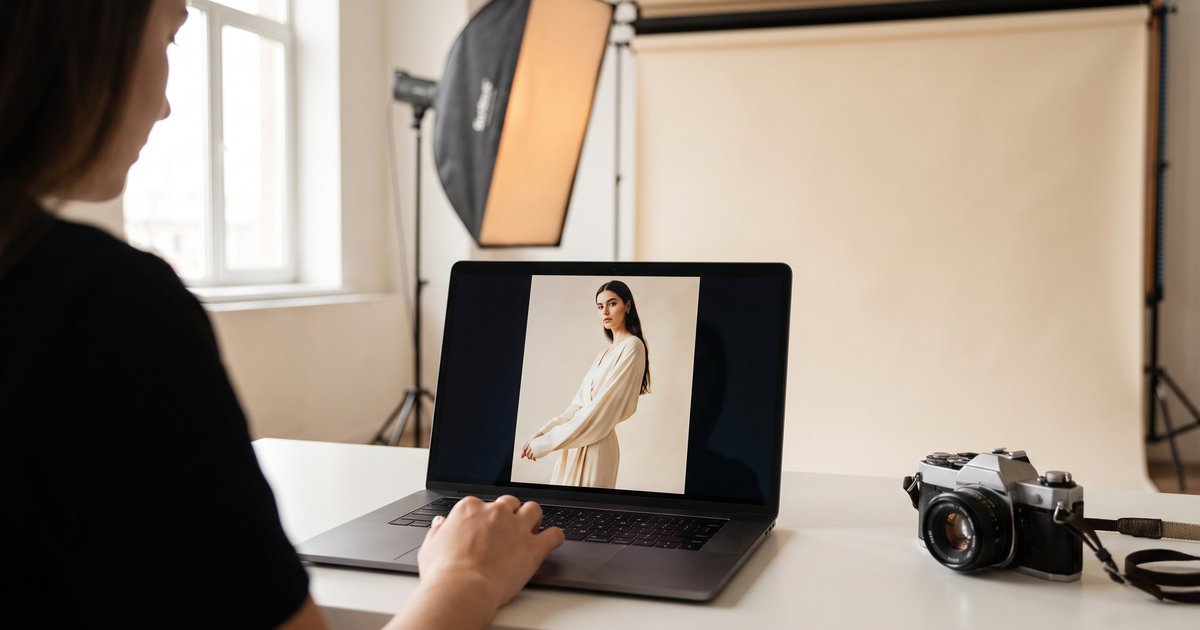
Fashion brands have been talking about "AI photoshoots" for two years, but until 2026 most of what you saw was uncanny: shoes with five eyelets, prints that drifted across a garment, models with hands borrowed from a different body. That problem is now solved well enough for production work, and the cost gap is finally too large to ignore.
This post breaks down what changed, what an honest cost comparison actually looks like, and where you should — and should not — replace your camera.
The real cost of a traditional shoot
The "shoot costs ₹2 lakh" number you see quoted everywhere is the photographer's invoice. It hides the rest of the production stack. A realistic cost sheet for a 30-SKU on-model shoot in Mumbai or Bangalore looks like this:
| Line item | Range (INR) |
|---|---|
| Photographer + assistant (1 day) | 35,000 – 70,000 |
| Studio rental (1 day) | 15,000 – 40,000 |
| Model fee (1 day, mid-tier) | 20,000 – 60,000 |
| Hair & makeup artist | 8,000 – 18,000 |
| Stylist + steamer / on-set prep | 6,000 – 15,000 |
| Lighting + grip + backdrop rental | 10,000 – 25,000 |
| Post-production retouching (₹400–₹900/image × 30) | 12,000 – 27,000 |
| Sample shipping, alterations, reshoot allowance | 8,000 – 20,000 |
| Total | ₹1.14 L – ₹2.75 L |
That excludes management overhead — the brand-side time spent briefing, scheduling, QA-ing, and chasing files. For a 100-SKU drop you typically run a 2–3-day shoot block at ₹3.5–8 lakh, with finished imagery landing 4–6 weeks later.
Compare that to AI fashion photography, where the inputs are: a clean front-and-back flat-lay of each SKU, a brand model reference (or a stock model), and a wardrobe brief. The unit cost collapses to the inference cost plus the platform margin — for SocialShot's Product Photoshoot pipeline, ₹15–40 per finished image depending on resolution and pose count.
For 30 SKUs at 4 looks each (120 images): ~₹2,400 total, delivered in an afternoon.
Where the 90% saving actually comes from
The cost compression is not magic. Three real things change:
- You stop renting time. Studios, models, and crews are billed by the day. AI generation is billed by the output. A 30-SKU day and a 300-SKU day cost the same in a studio because the day is the unit. In AI photography the unit is the image, and the marginal cost flatlines.
- You stop re-shooting. Roughly 18–25% of traditional shoot output gets reshot — a missed angle, the wrong shoe, a wrinkled hem caught in post. AI regeneration is non-destructive: you tweak the prompt and ship 30 seconds later. There is no second studio day.
- You stop waiting on people. A traditional shoot is gated by stylist availability, model availability, and the retoucher's queue. AI imagery is gated by your decision speed, which means the same brand merchandiser ships 5× more catalog per week without hiring.
The 90% figure is not theoretical. Internal customer audits across our DTC apparel cohort (Q1–Q2 2026) put the all-in saving — including the editorial QA pass — at 87–93% for catalog imagery and 78–84% for ad creative, where you still need a tighter human curation step.
The product-fidelity question
"Cheap" and "studio-quality" used to be a contradiction in AI fashion photography. The break came when generation pipelines moved from text-prompted models to garment-conditioned models — meaning the system is handed the actual product photograph as a fidelity reference and is told the model and scene are the negotiable variables, not the product.
The four fidelity tests we run on every output before it ships:
- Print and pattern integrity. Does the floral repeat actually repeat? Do stripes stay parallel across folds? Pattern drift is the single biggest tell of an AI image.
- Trim and hardware fidelity. Buttons, zippers, drawstring tips, heel hardware. If the original has six buttons, the output must show six buttons.
- Fabric drape and weight. A linen kurta drapes differently from a polyester one. The output should respect the fabric class even when the pose changes.
- Color truth. Hex-locked output within ΔE ≤ 3 vs. the source. This is what makes the difference between an Instagram tile and a returns disaster.
SocialShot's pipeline is built around exactly these four guardrails — see Product Photoshoot for the input spec, and the dedicated Brand Models workflow for locking a single recognizable model identity across an entire catalog (the thing that makes a Shopify PDP feel like a real brand and not a Pinterest board).
The workflow most DTC brands settle on
After working with ~200 apparel brands over the last year, the workflow that consistently wins is not "replace the whole shoot." It is a tiered split:
| Use case | Method | Why |
|---|---|---|
| PDP hero image (the first product image on Amazon, Shopify, Myntra) | AI, locked model, 4K | Volume + spec-compliance + cost |
| PDP lifestyle variants (3–6 per SKU) | AI, varied scenes | Same model, different settings = consistent brand feel |
| Marketplace gallery (detail crops, swatches) | AI + AI-upscaled crops | Platforms require specific dimensions; AI ships pixel-perfect |
| Hero campaign / brand film stills | Traditional shoot | Emotional storytelling, founder POV, real human texture |
| Influencer / UGC | Mixed — AI for hero, real UGC for trust | You cannot fake a real customer wearing your hoodie |
The brands seeing the biggest top-line lift are using AI to stop rationing catalog imagery. When a hero shot costs ₹15 instead of ₹2,000, you stop asking "do we really need a back view of this SKU?" and you ship the back view. Conversion rate on PDPs with 5+ images is consistently 22–34% higher than PDPs with 2–3, and that 22–34% is now affordable to capture.
A realistic 30-day pilot plan
If you are sizing this for a brand right now, here is the cheapest meaningful test you can run:
- Week 1. Pick 10 SKUs from a single category (kurtas, denim, sneakers — keep it tight). Flat-lay them on white, front and back, 4K. Pick a model identity in Brand Models.
- Week 2. Generate 4 looks per SKU (1 PDP hero + 3 lifestyle variants). Run them through your usual QA checklist. Note rejection rate.
- Week 3. Replace the imagery on those 10 PDPs. Leave the rest of the catalog untouched as a control. Tag the experiment in your analytics tool.
- Week 4. Compare PDP conversion rate, time-on-page, and (if you have it) return rate on those 10 SKUs vs. the control. Most brands see the directional answer within 2,000–3,000 sessions per SKU.
The investment for that pilot, on SocialShot's pricing, lands at ₹600–1,500 total — less than the cost of a single shoot reshoot.
Where AI fashion photography should not replace your camera
We are not maximalists about this. Three places where you should still spend on a real shoot:
- Founder-led brand storytelling. The texture of a real face in a real room is the asset; AI is the wrong tool.
- Editorial / campaign hero shots. Once or twice a year — give those the budget.
- Compliance-critical categories. Certain regulated goods (e.g. anything making a medical/wellness claim) need genuine human imagery on file.
For the other 80% of your output — the PDP volume that actually moves revenue — AI is now the right default.
Get started
Spin up a free trial in 60 seconds and run the 10-SKU pilot this weekend. The pricing page has the per-image math; the Product Photoshoot page has the input checklist.
If you would like a 1:1 audit of your current shoot stack — what to keep, what to migrate, where the biggest saving sits — reach out at hello@socialshot.ai with "Shoot audit" in the subject and a link to your storefront.
FAQ
How is AI fashion photography different from a virtual try-on?
Virtual try-on shows a real customer how a garment might look on them. AI fashion photography produces the on-model imagery a brand publishes on its PDP, ads, and social. Different end-users, different workflows.
Will Google or Amazon penalize AI-generated product imagery?
No, as of mid-2026. Google's spam policies target deceptive AI content; product imagery that accurately represents the SKU is not penalized. Amazon's image policy is dimension- and content-rule based — it does not distinguish AI from camera. Always disclose if you use AI imagery in editorial content (e.g. influencer posts), per India's ASCI guidelines.
What happens if the print on the garment is intricate?
Use the highest-fidelity tier in Product Photoshoot and feed a high-resolution flat-lay (≥ 4K, even illumination). Pattern integrity is the variable that scales hardest with input quality — bad in, drift out.
How do I keep the same model across all my SKUs?
Brand Models locks a single model identity (face, body type, skin tone) as a reusable asset across your catalog. This is what makes a Shopify store feel like a brand rather than a stock-photo collage.
Is this only for apparel?
The cost math is best for apparel and footwear, where on-model imagery is mandatory. Accessories, beauty, and home goods see a smaller (but still 60–75%) saving because they require less on-model work to begin with.
Last updated: 28 June 2026. We update this post quarterly with the latest cost benchmarks. Want our shoot-audit checklist? Subscribe at the [blog index](/blog).