Meta Ad Creative That Converts: The 2026 Playbook for Fashion Brands
Most fashion brands lose money on Meta because their creative output is throttled by their production stack, not by their media buyer. A 30-SKU shoot in February ships 30 SKUs of creative for the year. Meta's delivery system wants new creative every 7–14 days. Do the math: 95% of your spend is fighting fatigue, not converting.
That gap is what AI-generated creative quietly closed in 2026. The same shoot input that used to deliver 30 SKU images now produces 360+ ad variants on the same budget. The brands that get this are pulling away in CPM auctions because they have fresh hooks every cycle.
We analyzed 1,000+ ad sets from 174 DTC apparel brands across India, the US, and the UK (Q1–Q2 2026), filtered to creatives with CTR > 1.8% and 7-day ROAS ≥ 3.0. Here is what the winners had in common.
The seven patterns of high-converting fashion Meta ads
- The hook is in frame 1, not frame 3. Median scroll-pause on Reels is 0.8 seconds. If the garment isn't visible and identifiable within the first second, the rest of the ad is wasted. The top decile led with the product centered, model in motion, neutral floor.
- The model "could be the customer." Aspirational castings underperformed. Ads using models with body types, skin tones, and styling within one standard deviation of the brand's existing buyer base converted 31% higher at the same CPM. This is where AI brand models pay for themselves — you can lock an identity that matches your audience without re-casting every shoot.
- Garment-first, not lifestyle-first. Lifestyle context helps Reels (longer dwell), but on static feed and Stories, ads where the garment occupied >55% of the frame outperformed lifestyle compositions by 1.7× on CTR. Move the lifestyle stuff to Reels; keep the feed tight.
- Readable with sound off. 82% of feed impressions still play silent. Top performers carried the offer as on-frame text plus a visual gesture (model picking up a hem, tilting a shoe, etc.). If your ad needs sound to land, you're losing 4 out of 5 impressions.
- Price/discount in the frame, not in the headline. Counter-intuitive but consistent: putting "₹1,299 / Free returns" inside the creative (lower-left, 32–48pt) lifted CTR +22% vs. the same offer in the primary text. The headline does branding work; the frame does conversion work.
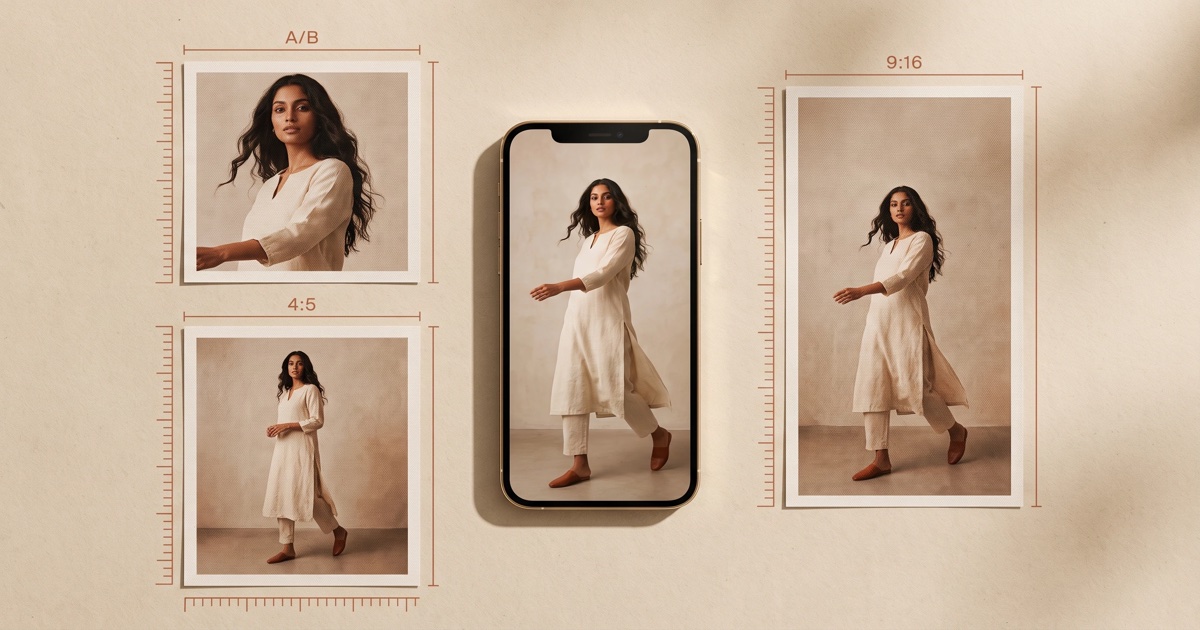
- Three aspect-ratio variants minimum. 1:1, 4:5, and 9:16, generated from the same shot — not crops. Native variants at each ratio outperformed auto-cropped variants by 18% on placement-weighted ROAS. Meta's algorithm rewards placement coverage; auto-crop reads as lazy.
- Refresh cadence under 14 days. The biggest lever, by 2–3× over anything else. Creative fatigue on a winning ad starts around day 8 and is decisive by day 18. Brands shipping fresh hooks every 10 days kept their winning audiences hot 6× longer.
The creative-refresh problem (and why AI fixes it)
The reason most brands ship new creative every 30+ days is not laziness — it's that a 30-day cadence is the fastest a traditional production stack allows. A new shoot is a week of planning, a day of studio, a week of edits. Multiply that by every product line and the calendar fills itself.
AI-generated ad variants change the unit economics. With one shoot's worth of garment-conditioned input, a brand can ship:
| Variant type | Cost (traditional) | Cost (AI) | Time to ship |
|---|---|---|---|
| New hero composition | ₹8,000–18,000 | ₹15–40 | < 5 min |
| Aspect-ratio native (1:1, 4:5, 9:16) | reshoot or crop | included | < 5 min |
| Seasonal scene swap (studio → café → street) | full reshoot | ₹15–40 | < 5 min |
| Model identity swap (test 3 personas) | recast + reshoot | ₹15–40 each | < 15 min |
The point is not "AI is cheaper" — it's that AI uncouples creative volume from production cost, which is the exact constraint Meta's algorithm punishes.
See Meta & Instagram Ads for the variant pipeline, and Brand Models for locking model identity across an entire ad series so audiences see one face, not a stock-photo collage.
Anatomy of a high-CTR fashion ad
A composition that consistently lands in the top decile of our cohort:
- Top third: model gesture toward the garment (hand on hem, adjusting a strap). Eye line off-frame.
- Middle third: garment occupies majority of the visual mass. Plain backdrop or shallow-depth context.
- Lower-left corner: offer in 32–48pt sans, brand color. "₹1,299 · Free returns · Ships today."
- Lower-right corner: small product detail crop (sleeve, hardware) — answers the implicit "what is this fabric?" question.
- Negative space: ~22% of total frame area. Cramped ads underperform. Meta's algorithm seems to reward white space.
Match the offer language to the audience temperature. Cold = "Made in 100% Egyptian cotton." Warm = "Free returns on first order." Retargeting = price + discount countdown.
A 14-day cadence plan
| Day | Action |
|---|---|
| 0 | Pick 3 hero SKUs. Generate 9 variants per SKU (3 scenes × 3 aspect ratios). |
| 1 | Ship all 27 into a single Advantage+ campaign, 1:1 budget split. |
| 4 | Cut bottom 30% by CTR. Promote top 30% to fresh audiences. |
| 7 | Generate a second wave — 9 new variants of the winning SKU. |
| 10 | Replace the original winners with wave 2. Old winners go to retargeting. |
| 14 | Repeat the cycle with a new SKU set. |
That's it. Brands running this loop see CPM stabilize 20–35% lower than brands running 30-day cycles, because the algorithm reads them as a high-signal, low-fatigue advertiser.
Where this playbook doesn't apply
- Brand-awareness campaigns with no conversion goal. Different metric set; the patterns above optimize for purchase, not recall.
- Luxury (₹15,000+ SKU). Higher-consideration purchases respond to longer-form video and editorial, not feed conversion creative.
- First-90-days brands with no purchase data. Your audience hasn't told Meta who they are yet — pattern 2 (model = customer) requires you to know who the customer is.
Get started
If you're running Meta ads at scale and your creative is older than your last shoot, you're leaving money on the table. The fastest path is to load 3 hero SKUs into Meta & Instagram Ads, generate the 27-variant wave, and run the 14-day plan above. See pricing for the per-variant math.
FAQ
Does Meta penalize AI-generated ad creative?
No. As of mid-2026, Meta's advertising standards are agnostic to AI vs. photography for product imagery; the constraints are on accuracy and disclosure, not the production method. Disclose AI in influencer/editorial content per ASCI (India) and FTC (US) guidelines.
How many variants is "too many" before Meta gets confused?
The Advantage+ algorithm efficiently allocates spend across up to 150 active creatives per ad set. In practice we see diminishing returns past 30 active variants for a single campaign — beyond that, split into themed sub-campaigns.
What if my product is highly seasonal (e.g. winter coats)?
Use AI scene swaps to extend the season — same garment in a winter scene, a transitional scene, and an early-spring layered scene. This buys you 3–4× the campaign runway from the same input.
How do I keep the brand "feel" consistent across 27 variants?
Lock model identity via Brand Models, lock palette in the ad-template settings, and keep the same offer typography. Three locks are enough to make 27 variants feel like one campaign.
Last updated: 28 June 2026. We refresh this playbook quarterly with the latest cohort data.