Marketplace Listing Optimization: Amazon, Etsy & Shopify Image Specs
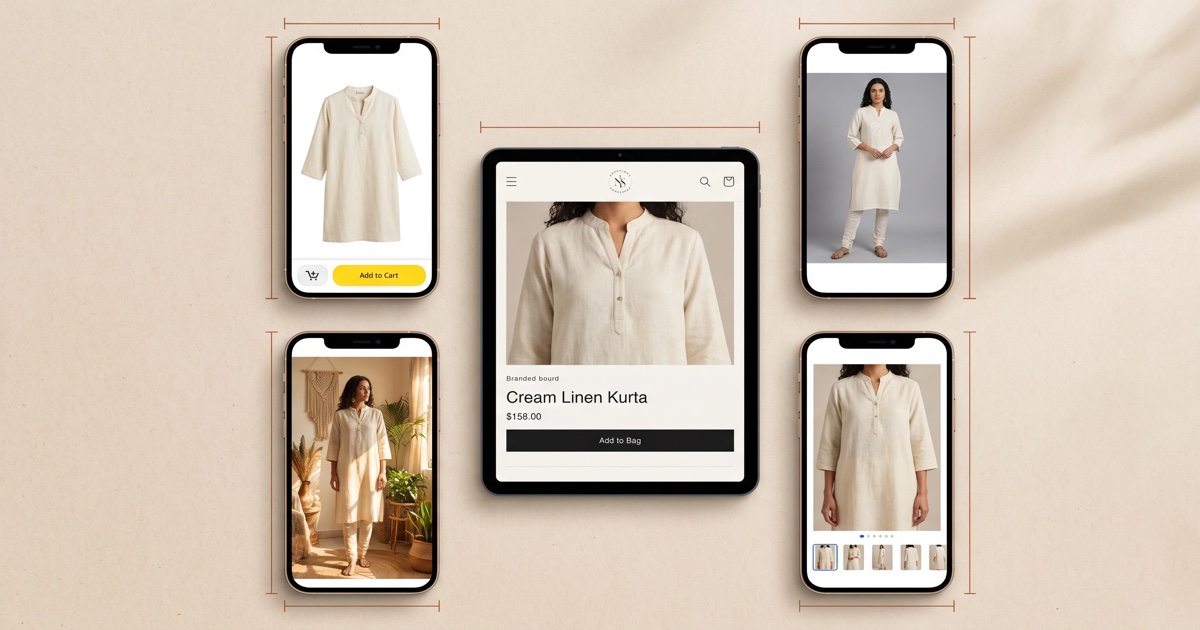
Most fashion brands lose marketplace conversion because they ship one shoot's worth of imagery to every platform. The image that converts on a Shopify PDP is not the image that wins on Amazon search. The image that gets featured on Etsy is not the image Myntra surfaces in its grid. Below is the spec sheet, the three-shot anatomy that satisfies all of them, and a refresh workflow that takes an afternoon.
The five specs that matter
| Marketplace | Hero image | Lifestyle / variant | Detail crops | Notes |
|---|---|---|---|---|
| Amazon | 2000×2000, pure white background (#FFFFFF), product fills 85% of frame, no text/watermark | 1600×1600+, lifestyle, on-model OK | 2000×2000, close crops on stitching, fabric, hardware | Zoom requires ≥ 1000px on long edge; below that, the listing loses the zoom widget. Up to 9 images. |
| Shopify | 2048×2048 recommended, any background, brand-fit | 2048×2048, lifestyle | 2048×2048 detail crops | Far more flexible than marketplaces — use it for brand expression, not compliance. |
| Etsy | 2000×2000, brand-fit background, product centered | 2000×2000, lifestyle, hand/scale references reward well | 2000×2000 detail | Etsy's algorithm favors handmade-feeling lifestyle context. First image dominates click-through. |
| Myntra | 1500×2000 (3:4, min 1080×1440), pure white background (#FFFFFF), on-model preferred | 1500×2000, on-model lifestyle | 1500×2000 detail crops | Strict 3:4 aspect. Off-aspect images get auto-cropped badly. Background is pure white, not grey — matches our own Marketplace Photos compliance preview. |
| Flipkart | 1500×1500 (1:1, min 500×500), white background, on-model OK | 1500×1500, lifestyle | 1500×1500 close-ups | Up to 8 images. First 4 dominate the mobile carousel. Flipkart's true minimum is far lower than Amazon's — 500×500px, not 2000×2000. |
This table is the most-asked question we get. Save it.
The three shots every listing needs
Every marketplace, every category, every brand. Get these three right and the rest is texture.
1. The hero shot
The first image the shopper sees. Its job is one thing: communicate what the product is in 0.3 seconds. On Amazon and Flipkart, this means a clean on-model or product-only shot against the platform's required background. On Shopify and Etsy, you have brand latitude.
The hero shot is not the place for mood. Save mood for image 2. The hero shot is for fast recognition.
2. The lifestyle variant(s)
Two to four images that answer what is it like to wear this? Different scenes, different settings, ideally the same model identity (this is where Brand Models earns its keep). The lifestyle set is where consideration happens — the shopper has already understood what the product is, and now is asking whether they want it.
3. The detail crops
One to three tight images that prove the quality. Stitching, fabric texture, hardware, lining, soles, pocket detail. These reduce returns by 8–14% on apparel because they answer the "what is the actual fabric?" question before purchase, not after delivery.
Marketplaces that allow video (Amazon, Myntra, Flipkart, increasingly Shopify) reward a 6–10 second close-up reel of the same details. Same source content, different format.
The conversion math
On a typical apparel listing, image quality moves the conversion needle more than copy or price. Our cohort data on listings refreshed in Q1 2026:
| Change | Conversion lift (median) |
|---|---|
| Hero image meets Amazon spec (was off-spec) | +27% |
| Added 2+ lifestyle variants (was hero-only) | +18% |
| Added 3+ detail crops (was hero + lifestyle only) | +12% |
| Locked model identity across all images (was mixed models) | +9% |
| Added a 6-second product video | +14% |
These are not additive — there's overlap — but the floor is real. A listing that does all five sits at roughly +45–60% above a hero-only baseline. That's why the brands you compete with on Amazon ship 9 images and you ship 3.
The 1-hour catalog refresh workflow
The reason most brands don't refresh listings to platform spec is that doing it the traditional way — a reshoot or studio re-crop — takes weeks. The AI workflow takes an afternoon.
| Step | Time | What you do |
|---|---|---|
| 1 | 10m | List your top 20 SKUs by traffic. These are the only listings worth refreshing first. |
| 2 | 10m | Pull current imagery; tag what's missing per marketplace (hero compliance, lifestyle count, detail crops). |
| 3 | 25m | Generate the missing images via Marketplace Photos — the pipeline outputs native specs for Amazon, Shopify, Etsy, Myntra, Flipkart from a single garment input. Platform-specific walkthroughs: Myntra product photography and Meesho product photography. |
| 4 | 10m | Run the four-test fidelity check (see Product Fidelity in AI Generation) on each output. |
| 5 | 5m | Push to platforms via the listing tool of your choice. |
Most brands see the first conversion lift within 48 hours of the refresh, because marketplace algorithms re-rank listings on engagement signal almost immediately.
What not to do
- Don't crop a 4:5 hero to 1:1 for Amazon. Auto-crop kills composition. Generate a native 1:1 source.
- Don't ship the same lifestyle shot to every marketplace. Etsy's audience and Myntra's are not the same audience. The grain, scene, and model styling that converts on one underperforms on the other.
- Don't compress images to "save bandwidth." Marketplaces reward source quality at scoring time. Upload the largest spec the platform accepts.
- Don't skip detail crops. They are the single highest return-reduction lever and the cheapest to produce.
Get started
Pull your top 20 SKUs and your current image set, then run the 1-hour workflow above with Marketplace Photos. See pricing for the per-image math.
FAQ
Will Amazon flag AI-generated hero images?
No, as long as the image accurately represents the product and meets the spec (white background, 85% fill, no text). Amazon's policy is content- and spec-based, not source-based.
What about Etsy's "handmade" policy?
Etsy's policy is about the product being handmade, not the imagery. AI-generated photography of a handmade product is allowed; misrepresenting the product itself is not.
What's the best image to put first?
Hero shot for marketplaces (Amazon, Myntra, Flipkart). On Shopify and Etsy, the highest-converting lifestyle shot — your audience is already on your storefront and is in consideration mode, not recognition mode.
How often should I refresh marketplace images?
Hero shots: every 6–9 months. Lifestyle variants: every 3 months, ideally seasonal. Detail crops: only when the product itself changes.
Do I need separate sets for desktop vs. mobile?
No — all five marketplaces serve the same source image to both, scaled. Optimize for mobile composition (more vertical white space, larger product), since 70–85% of traffic is mobile.
Last updated: 28 June 2026. Spec table verified against current marketplace seller-center docs as of June 2026; platforms occasionally tweak — we re-verify quarterly.